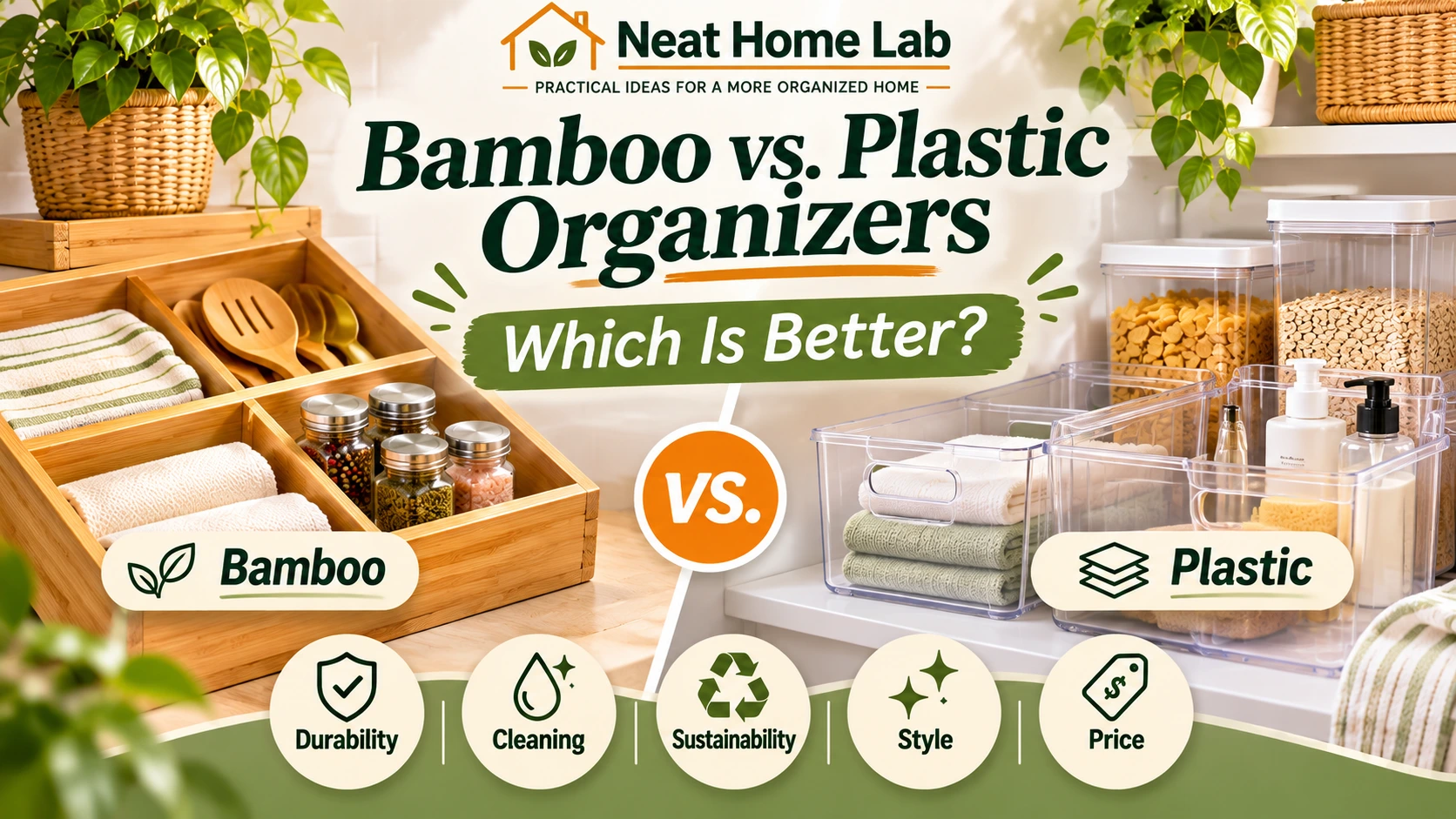
Bamboo and plastic organizers can both work well, but they solve different storage needs. Bamboo is often a better fit when appearance and a warm natural look matter, while plastic can be more practical when visibility, easy cleaning, moisture exposure, or flexible sizing are priorities.
The better choice depends on where the organizer will be used, what it needs to hold, how often it will be cleaned, and whether you want the storage itself to remain visible.
Keep this guide handy when choosing organizers for kitchens, pantries, bathrooms, closets, drawers, and visible shelving.
Quick Answer: Bamboo vs. Plastic Organizers
- Choose bamboo when appearance, natural texture, and visible storage are important.
- Choose plastic when easy cleaning, visibility, moisture tolerance, or flexible shapes matter more.
- Use the storage environment as the deciding factor rather than choosing by appearance alone.
- Measure the space before buying either material.
- Check the exact care instructions for the product you are considering.
Bamboo Organizers: Where They Work Best
Bamboo organizers can make drawers, shelves, counters, and open storage feel warmer and more finished. They are often chosen when the organizer itself will remain visible and appearance matters almost as much as function.
Best for Visible Storage
Bamboo trays, boxes, drawer organizers, and shelf accessories can blend easily with wood cabinets, neutral interiors, and open shelving. They may be especially appealing in spaces where clear or brightly colored plastic would feel visually distracting.
Useful for Dry Drawers and Shelves
Bamboo can work well in dry storage areas such as utensil drawers, office drawers, closet shelves, dresser drawers, or pantry locations that are not regularly exposed to spills or moisture.
Good When You Want a More Finished Look
If the organizer is visible on a countertop, open shelf, or inside a frequently opened drawer, bamboo can create a more furniture-like appearance than many basic plastic bins.
- Check whether the area stays reasonably dry.
- Review the manufacturer’s cleaning instructions.
- Measure carefully because rigid bamboo organizers may offer less flexibility than modular plastic systems.
- Consider whether stains or frequent spills are likely.
Plastic Organizers: Where They Work Best
Plastic organizers are practical when visibility, frequent cleaning, moisture exposure, stackability, or a wide range of shapes and sizes are more important than a natural appearance.
Best for Visibility
Clear plastic bins can make it easier to see pantry goods, toiletries, refrigerator items, craft supplies, or other stored categories without pulling every container from the shelf.
Useful in Areas That Need Frequent Cleaning
Many plastic organizers can be wiped or washed more easily than natural-material storage. This can make them convenient in kitchens, bathrooms, utility spaces, and other areas where spills or residue are more likely.
Good for Modular Storage Systems
Plastic organizers are available in many shapes, depths, widths, and stackable formats. That flexibility can be useful in small spaces where several containers need to fit together efficiently.
- Check the exact dimensions rather than relying on product photos.
- Confirm whether the plastic type is appropriate for the intended use.
- Review care instructions and temperature limitations when relevant.
- Make sure stacking does not make frequently used items difficult to reach.
Bamboo vs. Plastic Organizers: Side-by-Side Comparison
| Storage Priority | Bamboo | Plastic |
|---|---|---|
| Natural appearance | Usually the stronger choice | More utilitarian unless designed decoratively |
| See contents quickly | Usually limited unless open-top | Clear versions are especially useful |
| Frequent wiping or washing | Depends heavily on finish and care instructions | Often easier to clean |
| Moisture-prone area | Requires more care and product-specific guidance | Often more practical, depending on product design |
| Variety of shapes and sizes | Available, but often more limited | Usually available in many modular formats |
| Visible countertop or open shelf | Strong choice when appearance matters | Good when function and visibility matter more |
| Drawer organization | Good for structured, finished-looking layouts | Good for modular or frequently changing layouts |
| Stackable storage | Depends on product design | Many stackable options are available |
Durability: Which Material Holds Up Better?
There is no single winner for durability because construction quality, thickness, finish, intended use, and storage conditions matter as much as the material itself.
Bamboo Durability
A well-made bamboo organizer may work well for long-term dry storage, especially when it is not repeatedly exposed to water or harsh cleaning. Check the care instructions because finishes and construction methods vary between products.
Plastic Durability
Plastic organizers can be practical for frequent handling and cleaning, but rigidity and durability vary widely. Thin plastic may flex more easily, while heavier designs may feel more stable.
Instead of asking which material is always more durable, ask which product is better suited to the environment and weight of the items you need to store.
Moisture and Cleaning
The amount of moisture in the storage area can strongly influence the better material choice.
For Bathrooms and Sink Areas
Plastic may be easier to manage where water splashes, humidity, or frequent cleaning are common. Bamboo products used in these areas should only be used according to their specific care and moisture guidance. For cabinet-fit considerations, see our under-sink organizers for small bathrooms guide.
For Dry Pantry and Closet Storage
Both materials can work well in dry areas. Here, appearance, visibility, dimensions, and how often the organizer needs to be moved may matter more than moisture resistance. Our small pantry organization ideas explain how to use bins and containers in compact spaces.
For Kitchen Drawers
Bamboo can provide a finished appearance for utensils and tools, while plastic can make it easier to create modular compartments or clean up crumbs and small spills.
Visibility and Everyday Access
Visibility is often overlooked when choosing organizers. If you regularly forget what is stored inside opaque containers, clear plastic may reduce unnecessary searching.
On the other hand, if the organizer is open on top or stored in a drawer where contents are already visible, bamboo can provide the structure you need without sacrificing access.
Choose transparent or open storage when seeing the contents helps you maintain the system. Choose decorative storage when the organizer itself will remain visible and visual simplicity matters more.
Flexibility and Sizing
Plastic organizers often offer more modular sizes, narrow bins, stackable containers, drawer trays, and specialized shapes. This can make them easier to combine in irregular cabinets or very small spaces.
Bamboo organizers can still be flexible, especially expandable drawer trays or modular boxes, but measure carefully because rigid sides can leave unusable gaps if the dimensions are slightly wrong.
Which One Should You Choose?
Choose Bamboo If…
- You want a warm, natural look.
- The organizer will be visible.
- The storage area is generally dry.
- You prefer structured trays or boxes with a finished appearance.
- You already know the exact dimensions you need.
Choose Plastic If…
- You want to see stored items quickly.
- The organizer may need frequent wiping or washing.
- The area may be exposed to moisture or occasional spills.
- You need several modular sizes or stackable options.
- Function and flexibility matter more than natural appearance.
Use Both Materials If That Works Better
You do not need to use the same material throughout your home. Bamboo may work well in visible dry areas, while clear plastic may be more practical inside the pantry, bathroom, refrigerator, or utility storage.
Choose the material according to each storage environment instead of trying to create one material rule for the entire home.
Amazon Shopping Checklist
- Measure usable width, depth, and height.
- Decide whether visibility or appearance matters more.
- Consider moisture, spills, and cleaning frequency.
- Check whether the organizer needs to stack or expand.
- Compare materials, construction, capacity, and care instructions.
- Make sure frequently used items will remain easy to reach.
- Verify the exact current Amazon listing before ordering.
Affiliate disclosure: As an Amazon Associate I earn from qualifying purchases. The Amazon link below is a paid affiliate link.
Compare Bamboo and Plastic Organizers
Comparing both materials side by side can help you choose based on storage environment, dimensions, visibility, cleaning needs, and appearance rather than material alone.
Consider bamboo if: You want a natural-looking organizer for a generally dry drawer, shelf, closet, or visible storage area.
Consider plastic if: You want clear visibility, modular sizing, easier cleaning, or storage that may experience more moisture or spills.
- Compare exact exterior and interior dimensions.
- Check material and care information.
- Review stackability or expansion features if needed.
- Confirm the design suits the intended environment.
- Verify current product information before purchasing.
View on Amazon(paid link)
This link opens Amazon search results rather than one tested or ranked product. Check the exact listing, dimensions, materials, care instructions, current price, seller information, and return terms before ordering.
Try This Before Buying New Organizers
Choose one problem area and test the layout using containers you already own. If you discover that visibility is the main problem, clear storage may be more useful. If the system works but looks visually cluttered, a more finished bamboo organizer may make sense.
Testing the category first helps you determine what dimensions, shape, and material you actually need before spending money.
Frequently Asked Questions
Are bamboo organizers better than plastic organizers?
Neither material is universally better. Bamboo can be a strong choice for dry, visible storage where appearance matters, while plastic can be more practical when visibility, easy cleaning, moisture exposure, or modular sizing are priorities.
Are bamboo organizers good for kitchens?
They can work well in dry kitchen drawers, cabinets, or visible storage areas when used according to the manufacturer’s care instructions. Areas exposed to frequent water or spills may require more careful material selection.
Are plastic organizers better for bathrooms?
Plastic can be practical in bathrooms because many designs are easy to wipe clean and can work in moisture-prone environments. Always check the specific product’s intended use and care instructions.
Which material is easier to clean?
Plastic is often easier to wipe or wash, although cleaning instructions vary by product. Bamboo usually requires more attention to the manufacturer’s care recommendations and should not automatically be treated like plastic.
Which organizer material is better for a pantry?
Clear plastic can be useful when seeing food categories quickly matters, while bamboo can work well when you prefer open bins, trays, or a more decorative appearance. Shelf dimensions and access should guide the decision.
Can I mix bamboo and plastic organizers?
Yes. Using different materials in different areas can be more practical than forcing one material throughout the home. Choose each organizer according to its environment and purpose.
This comparison is intended to help you evaluate bamboo and plastic organizer categories according to common storage priorities such as appearance, visibility, cleaning, moisture, sizing, and access. It does not represent hands-on testing or a claim that one material is always superior. Always verify the current Amazon listing, dimensions, materials, care requirements, compatibility, seller information, price, and return terms before purchasing.