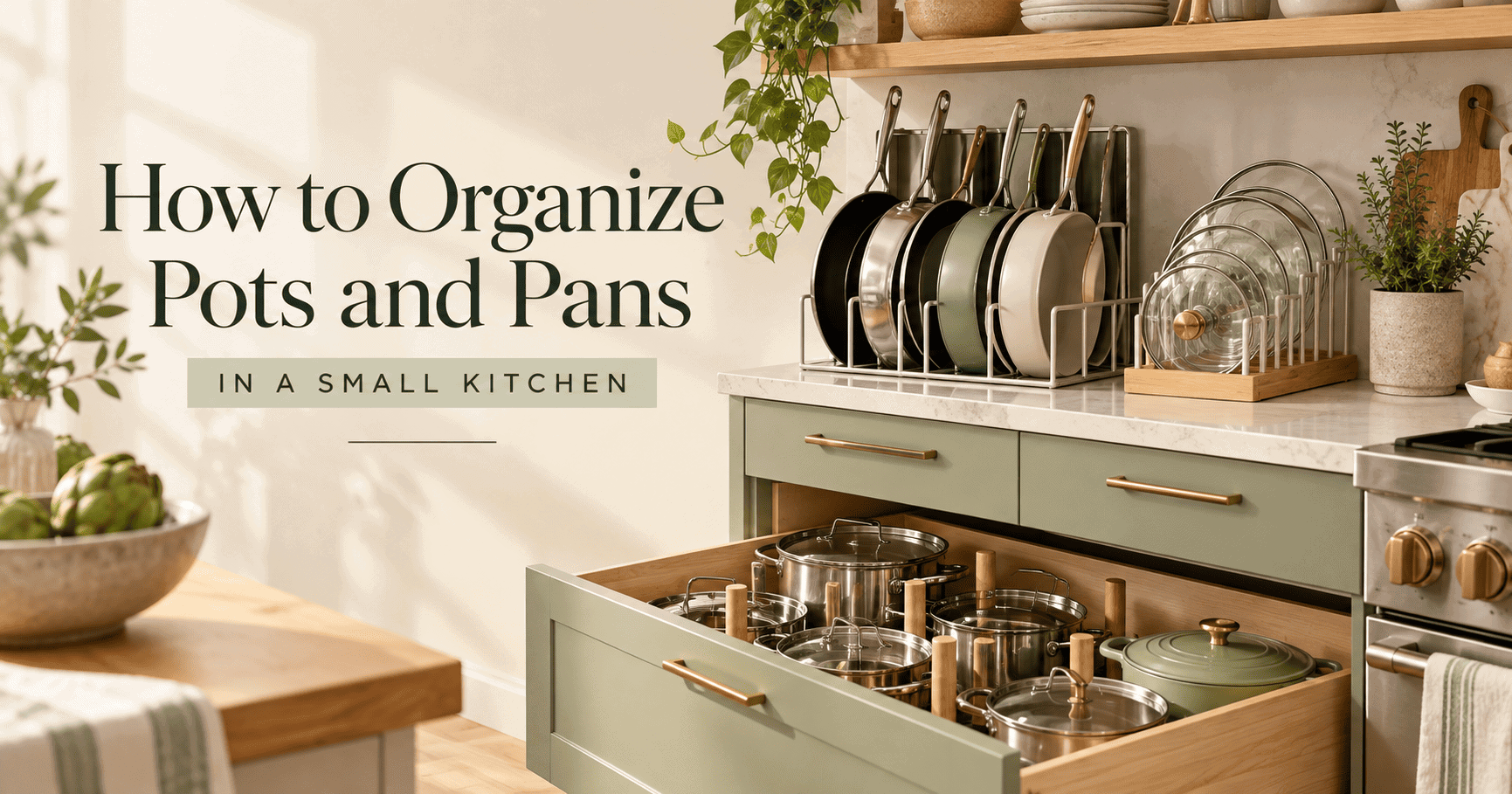
If opening a kitchen cabinet means moving three pans just to reach the one you need, your cookware storage system is probably working against you. Learning how to organize pots and pans in a small kitchen is less about fitting more cookware into the space and more about making every piece easier to see, reach, and put away.
The best setup depends on your cabinet depth, drawer space, cookware sizes, and how often you actually use each pot or pan. These 12 practical ideas will help you organize cookware without remodeling your kitchen or wasting valuable storage space.
Quick Takeaways
- Declutter cookware before buying additional organizers.
- Store everyday pots and pans in the easiest-to-reach zone.
- Vertical storage can make frying pans and lids easier to access.
- Deep cabinets work better when divided into front and back zones.
- Measure cabinet interiors before choosing racks, risers, or pull-out organizers.
Start Here: Decide What Cookware You Actually Need
Before rearranging cabinets, take out your pots, pans, lids, and larger cookware. A small kitchen becomes much easier to organize when you are not trying to store pieces you rarely use.
- Do I have duplicate pans that serve the same purpose?
- Are there lids that no longer match anything?
- Which pots and pans do I use every week?
- Which cookware is only used for holidays or special meals?
- Is anything damaged, warped, or no longer useful?
Your most frequently used cookware deserves the easiest storage positions. Large specialty pieces can usually move to less convenient cabinets or another nearby storage area.
If the entire kitchen feels crowded, start with our broader small kitchen organization guide for practical storage ideas for cabinets, counters, cookware, pantry areas, and other tight spaces.
12 Ways to Organize Pots and Pans in a Small Kitchen
1. Declutter Cookware Before Organizing It
Organizers cannot fix an overcrowded cabinet if you are storing more cookware than the space can realistically hold. Start by removing duplicate, damaged, or rarely used pieces.
Keep the cookware that matches the way you actually cook. A smaller collection with a clear purpose is usually easier to organize than a large collection arranged around complicated storage systems.
2. Match Pots With the Lids You Actually Use
Loose lids are one of the biggest sources of cookware clutter. Match each lid with its corresponding pot or pan and remove lids that no longer belong to anything.
If several pieces share the same lid size, you may not need a separate lid for every pan. Keep only what makes sense for your cooking habits.
3. Store Frying Pans Vertically Instead of Stacking Them
Traditional stacks save floor space inside a cabinet, but they often make individual pans difficult to reach. Vertical storage lets you slide one frying pan out without lifting several others first.
Freestanding dividers or cookware racks can work especially well in lower cabinets with enough height. Position the heaviest pans where the organizer has the strongest support.
If you want to compare different organizer styles, see our guide to the best pan and lid organizers for small kitchens.
4. Give Pot Lids Their Own Storage Zone
Lids usually become easier to manage when they have a dedicated location instead of being mixed between pots and pans.
A lid zone can be a narrow rack, a vertical divider, part of a deep drawer, or a safe section of a cabinet door. Store lids upright whenever possible so you can identify the size without digging through a stack.
5. Keep Everyday Cookware in the Easiest Cabinet
Prime kitchen storage should go to the items you use most. If you cook with the same skillet and saucepan several times each week, keep them near the stove or primary prep area.
Large stockpots, roasting pans, and specialty cookware can move farther away or higher up if they are used less often.
6. Divide Deep Cabinets Into Front and Back Zones
Deep cabinets become frustrating when cookware disappears behind other pieces. Instead of treating the cabinet as one large cavity, divide it into zones.
Keep daily cookware toward the front. Use the rear zone for larger or less frequently used pots. This prevents you from constantly removing one group just to reach another.
For more detailed strategies, see how to organize deep kitchen cabinets without wasting space.
7. Add a Freestanding Shelf Riser
A shelf riser can create a second usable level inside a tall cabinet without permanent installation. This can work well when smaller saucepans or lids leave unused vertical space above them.
Use the lower level for heavier cookware and the upper level for lighter pieces whenever possible.
8. Use Pull-Out Storage When It Solves an Access Problem
A pull-out organizer can make cookware at the back of a lower cabinet easier to reach, especially when bending and reaching into a deep space is inconvenient.
But a pull-out system is not automatically better for every cabinet. It can reduce usable width, so measure the interior carefully and consider the size of your largest cookware first.
For examples and fit considerations, see our guide to the best pull-out cabinet organizers for small kitchens.
9. Turn Deep Drawers Into Cookware Storage
If your kitchen has deep lower drawers, they can be one of the easiest places to store pots and pans. Unlike a deep cabinet, a drawer brings the cookware toward you.
Place heavier pots on the bottom and use dividers where needed to stop lids or smaller pans from sliding around. Avoid overloading drawers beyond their intended capacity.
10. Use Cabinet Doors for Lightweight Lids
The inside of a lower cabinet door can sometimes hold lightweight pot lids using a removable or door-mounted system.
Before adding anything, check hinge clearance and make sure the lids do not hit shelves, cookware, plumbing, or the cabinet frame when the door closes.
11. Move Rarely Used Cookware Out of Prime Kitchen Space
Your kitchen does not need to store every cooking item in the most accessible cabinets. Large holiday roasting pans, specialty pots, and oversized cookware may be better stored in a nearby pantry, closet, utility shelf, or another safe storage area.
Freeing even one lower cabinet can create enough room for a much simpler everyday cookware system.
12. Group Cookware by How You Actually Cook
Instead of organizing only by size, consider organizing cookware by function. Keep breakfast pans together, everyday saucepans together, or baking cookware in its own zone.
The goal is to reduce unnecessary movement. The cookware used together should ideally be stored near each other and near the area where you use it.
Try This Before Buying an Organizer
Before spending money on racks or pull-out systems, try rearranging the cookware you already own.
A Free 15-Minute Reset
- Remove every pot, pan, and lid from the cabinet.
- Eliminate duplicates and unmatched lids.
- Identify the cookware you use weekly.
- Put everyday pieces back first.
- Store pans vertically if your existing space allows it.
- Move rarely used pieces to the back or another storage area.
You may discover that the cabinet works much better without buying anything. If the remaining problem is access rather than capacity, an organizer may then be worth considering.
Best Cookware Storage Method by Cabinet Type
| Storage Area | Good Approach | Watch For |
|---|---|---|
| Deep lower cabinet | Front/back zones or pull-out storage | Hidden cookware in the rear |
| Narrow cabinet | Vertical pan and lid storage | Handle clearance |
| Tall cabinet | Shelf riser plus vertical dividers | Wasted vertical space |
| Deep drawer | Pots and pans stored flat or nested | Drawer weight limits |
| Cabinet door | Lightweight lid storage | Hinge and shelf clearance |
| Rental kitchen | Freestanding removable organizers | Permanent installation |
If you rent and want more reversible storage strategies, see 17 small kitchen storage ideas for renters that don’t require remodeling.
Measure Before You Buy Any Cookware Organizer
A pan rack or pull-out shelf can look compact online and still be too large for your cabinet. Always measure the usable interior space rather than relying on the cabinet’s exterior dimensions.
- Interior cabinet width
- Usable cabinet depth
- Interior height
- Door opening width
- Hinge clearance
- Width and height of your largest pan
- Length of pan handles
- Diameter of your largest pot lid
Remember that cabinet frames, hinges, plumbing, shelf supports, and doors can reduce the usable opening even when the interior looks larger.
Common Pots and Pans Storage Mistakes
Stacking Everything Into One Tall Pile
A large stack may look compact, but it forces you to lift several pieces whenever you need something near the bottom. Use smaller stacks or vertical storage when possible.
Buying an Organizer Before Measuring
This is one of the easiest mistakes to avoid. Measure the cabinet and your cookware before choosing a rack, riser, or pull-out solution.
Giving Rarely Used Cookware the Best Storage Space
Your prime cabinet zones should support your daily routine. Move specialty cookware away from the easiest-to-reach positions.
Ignoring Handles
A pan may technically fit inside a cabinet while its handle prevents the door from closing or blocks neighboring cookware. Include handles in your measurements.
Mixing Lids Everywhere
Scattered lids make cookware storage feel more chaotic than it needs to be. Give lids one predictable location whenever possible.
Trying to Use Every Inch
Some empty space is useful. A cabinet packed completely full may technically hold more cookware but can make everyday access much worse.
Frequently Asked Questions
What is the best way to organize pots and pans in a small kitchen?
Start by keeping only the cookware you use, then place everyday pieces in the easiest cabinet or drawer. Vertical pan storage, dedicated lid storage, shelf risers, and front/back cabinet zones can make small spaces easier to use.
Is it better to stack pans or store them vertically?
Vertical storage usually provides easier access because you can remove one pan without lifting several others. Stacking can still work well for lightweight pots or cookware used less frequently.
Where should pot lids be stored?
Keep lids together in a dedicated vertical rack, drawer section, cabinet-door organizer, or divider. The best location is one that keeps lids visible and close to the matching cookware.
How do I organize pots and pans in a deep cabinet?
Divide the cabinet into front and back zones. Keep everyday cookware at the front and less frequently used pieces farther back. Pull-out storage may also improve access when the cabinet dimensions allow it.
How can renters organize cookware without drilling?
Use freestanding pan racks, shelf risers, removable dividers, deep drawers, rolling storage, and other solutions that do not require permanent mounting.
Should pots and pans be stored near the stove?
Frequently used cookware is generally more convenient near the main cooking area, as long as the storage location is safe and does not interfere with appliance ventilation or access.
Final Thoughts
Learning how to organize pots and pans in a small kitchen starts with simplifying what you own and making everyday cookware easier to reach. You do not necessarily need more cabinet space—you need a storage system that matches your cookware, your kitchen layout, and the way you actually cook.
Start with decluttering and rearranging before buying an organizer. Then use vertical storage, dedicated lid zones, cabinet zoning, shelf risers, drawers, or pull-out solutions only where they solve a specific problem.