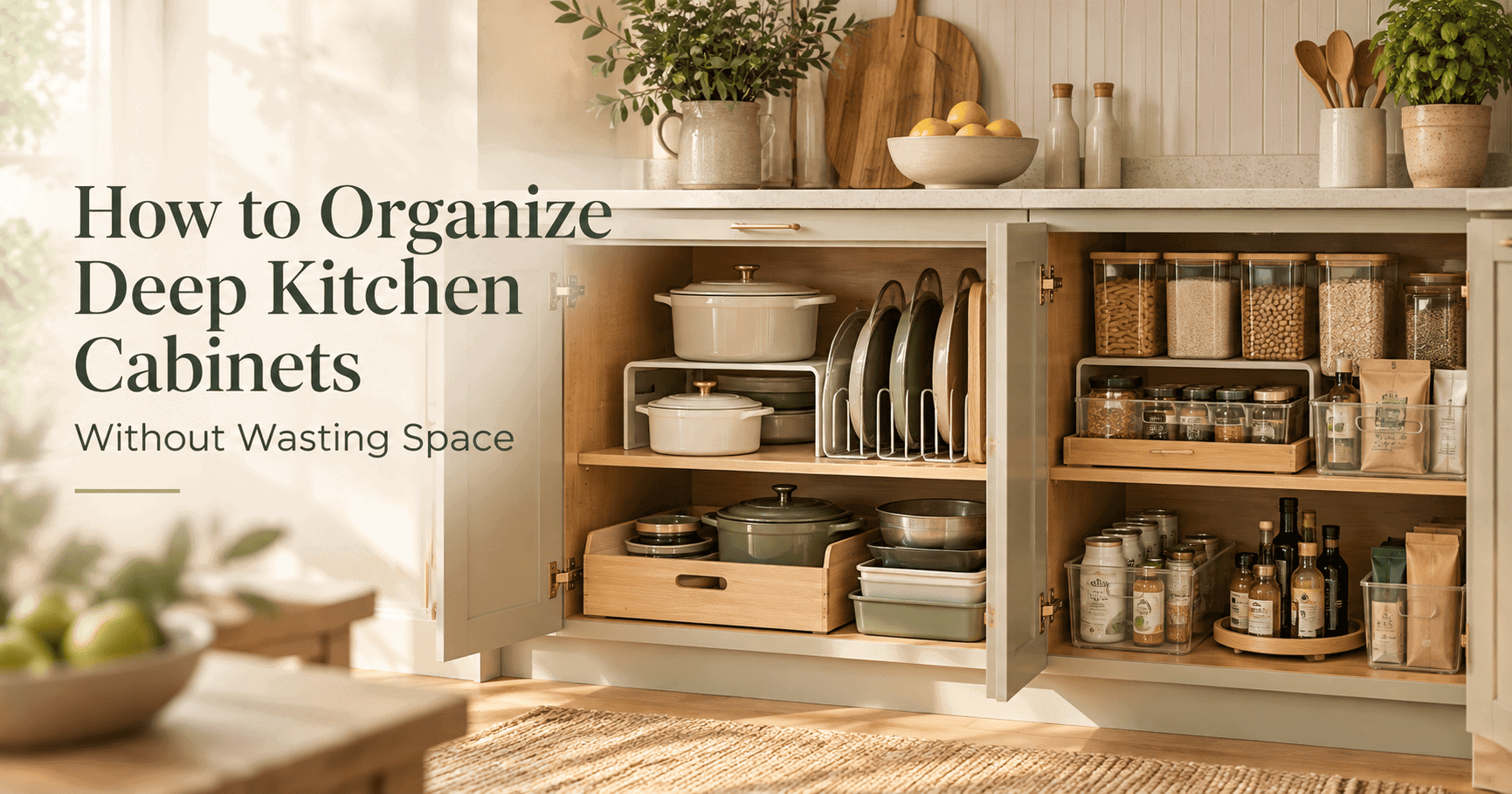
Deep kitchen cabinets can hold a surprising amount, but that extra depth often creates a different problem: the things in front hide everything behind them. Before long, cookware, food containers, pantry items, and small appliances disappear into the back of the cabinet.
The solution is not necessarily adding more cabinets or buying more organizers. A deep cabinet works better when you decide what belongs in front, what can live in the back, and how each item will move in and out of the space.
This guide shows you how to organize deep kitchen cabinets using practical zones, better stacking, vertical space, simple containers you may already own, and a few measurements that can prevent wasted space.
Quick Answer: How Should You Organize a Deep Kitchen Cabinet?
- Remove everything from the cabinet.
- Group similar items together.
- Measure the usable interior space.
- Keep frequently used items toward the front.
- Reserve the back for less frequently used items.
- Use vertical space instead of creating unstable stacks.
- Make deeper items movable whenever possible.
The goal is not to fill every inch. The goal is to make the cabinet easy to see, easy to reach, and easy to reset after use.
Why Deep Kitchen Cabinets Become Cluttered So Easily
Deep cabinets provide useful storage volume, but depth can reduce accessibility. Items at the front can hide what is behind them, while objects at the back may require reaching around or removing other things first.
The Back Becomes Invisible
If you cannot see an item, you are more likely to forget it is there. This is especially inconvenient with pantry ingredients, food-storage containers, and small kitchen tools.
Stacks Become Too Deep
Placing one group directly behind another can create two or three hidden layers. The cabinet may look full while still being difficult to use.
Too Many Categories Share One Cabinet
A cabinet containing pots, food containers, baking supplies, serving pieces, and miscellaneous appliances has no clear storage logic. Depth makes the problem worse because each category can disappear behind another.
Unused Height Gets Wasted
Deep cabinets can have substantial vertical clearance. If everything sits in one layer on the bottom, much of that usable volume remains empty.
Start by Emptying the Cabinet Completely
Trying to organize around existing clutter usually preserves the same problems. Remove everything from the cabinet so you can see the actual storage space.
Sort Items Into Simple Groups
Keep the categories practical rather than overly detailed. Depending on the cabinet, useful groups might include:
- Pots and pans
- Lids
- Food-storage containers
- Baking supplies
- Pantry ingredients
- Small appliances
- Serving pieces
- Occasionally used kitchen items
Remove What Does Not Belong There
If something is rarely used and occupies prime cabinet space, ask whether it could be stored somewhere less accessible. Likewise, duplicate or unused items should not remain simply because the cabinet has room for them.
The easiest-to-reach cabinet space should normally go to the items you use most often.
Measure Your Deep Cabinets Before Reorganizing Them
Even when you plan to organize with things you already own, measurements help you understand where usable space is being lost.
Measure Interior Width
Measure the usable width inside the cabinet rather than assuming it matches the exterior door width. Hinges, face frames, dividers, and other hardware can reduce usable space.
Measure Usable Depth
Measure from the usable front opening to the back wall. Then check whether hinges, plumbing, shelf supports, or other obstacles interrupt that depth.
Measure Vertical Clearance
Measure from the cabinet floor or shelf to the surface above it. This helps reveal whether you could store items vertically, create another usable level, or simply rearrange existing pieces more efficiently.
Measure the Cabinet Opening
This measurement is particularly important if you later consider a bin, basket, sliding shelf, or pull-out organizer. An organizer may fit inside the cabinet but still be unable to pass through the usable opening.
- Interior width
- Usable opening width
- Usable depth
- Vertical clearance
- Location of hinges and hardware
- Any plumbing or structural obstruction
Create Front and Back Storage Zones
One of the simplest ways to make a deep cabinet easier to use is to stop treating the entire depth as one storage area.
Front Zone: Everyday Items
The front should contain items you reach for frequently. Depending on the cabinet, that might mean your everyday skillet, food-storage containers, commonly used pantry ingredients, or a small appliance used several times a week.
Back Zone: Less Frequently Used Items
The rear is better suited to items that do not need daily access: specialty baking equipment, serving pieces, backup supplies, or appliances used occasionally.
Avoid Random Front-to-Back Rows
Do not place unrelated objects in front of one another simply because they fit. If the front item must be removed every time you need something behind it, the system creates unnecessary work.
Keep Related Items Together
If you must use both the front and back for the same category, keep related items together. For example, everyday baking ingredients could remain toward the front while specialty baking supplies occupy the rear.
How to Organize Different Items in Deep Kitchen Cabinets
1. Pots and Pans
Start by nesting cookware only when the pieces separate easily. Avoid building a tall stack that requires removing several heavy pieces to reach the pan at the bottom.
If you use only a few pans regularly, keep those toward the front and move specialty cookware farther back.
2. Pot and Pan Lids
Lids can consume unnecessary horizontal space when stacked flat. If your cabinet configuration allows it, storing lids vertically can make individual pieces easier to see and retrieve.
Before buying a lid organizer, test the idea with a sturdy divider, file-style holder, or another safe container you already own.
3. Food-Storage Containers
Nest containers by shape or size and keep lids in one predictable location. Avoid keeping every lid attached to its container if doing so consumes substantially more space.
Frequently used containers belong near the front. Larger containers used occasionally can move deeper into the cabinet.
4. Pantry Ingredients
Deep cabinets can work for pantry storage, but avoid creating multiple invisible rows of small packages.
Group related ingredients so you can move an entire category forward when needed. For example, baking supplies, snacks, or breakfast items can each function as a small zone.
If pantry storage is one of your bigger challenges, see our 15 Small Pantry Organization Ideas That Make the Most of Every Inch.
5. Small Appliances
Frequency of use should determine placement. An appliance used every morning should not be trapped behind one used only occasionally.
Before placing an appliance on an upper shelf, consider its weight and whether you can comfortably lift it from that position. Follow the cabinet or shelf manufacturer’s load guidance where applicable.
6. Baking Sheets and Cutting Boards
When cabinet height and configuration permit, flat items such as baking sheets, trays, and cutting boards may be easier to access when stored vertically rather than in a large horizontal stack.
7. Serving Pieces and Seasonal Items
These are often good candidates for deeper storage because they do not need prime front-row space. Keep them grouped so you know exactly where to look when they are needed.
How to Organize Deep Lower Cabinets
Deep lower cabinets can be especially frustrating because reaching the back often requires bending or kneeling.
Keep Heavy Everyday Items Within Easy Reach
Place frequently used cookware where it can be reached without moving several other heavy objects first.
Make the Back Movable
Instead of placing many loose objects deep inside the cabinet, group related items in a container you can safely pull forward as a unit.
A simple basket or sturdy bin you already own may be enough. The important feature is not the container itself—it is the ability to bring the back of the cabinet toward you.
Avoid Deep, Unstable Piles
Heavy cookware should not be arranged in a way that requires balancing or lifting an unstable stack. Accessibility and safe handling matter more than maximizing theoretical capacity.
How to Organize Deep Upper Cabinets
Upper cabinets create a different challenge: the rear may be difficult to see as well as difficult to reach.
Keep Frequently Used Items Lower and Forward
Everyday dishes, glasses, or ingredients should generally occupy the easiest-to-reach areas.
Use Higher or Deeper Areas for Lightweight Items
Less frequently used lightweight items can occupy less accessible areas. Avoid placing heavy objects where retrieving them requires awkward lifting or reaching.
Do Not Overfill the Top Shelf
A packed upper shelf can make every item harder to access. Leaving some open space may be more functional than maximizing every cubic inch.
Use Vertical Space Without Creating Unstable Stacks
Unused cabinet height is valuable, but simply stacking more objects is not always the answer.
Store Flat Items Vertically
Cutting boards, baking sheets, serving trays, and some lids can often use vertical storage efficiently.
Create a Second Level When Appropriate
If a cabinet has a large amount of empty height above short items, a stable shelf or riser may help create another usable level. Check dimensions and manufacturer load guidance before adding one.
Keep Stacks Short and Logical
Stack similar items together and avoid towers that must be dismantled every time you need something near the bottom.
What Should Go in the Very Back of a Deep Cabinet?
The back is not automatically wasted space. It becomes wasted when frequently needed items are stored there without an easy retrieval system.
Good candidates for rear storage can include:
- Occasional serving dishes
- Specialty baking tools
- Backup kitchen supplies
- Seasonal items
- Rarely used appliances
- Extra containers
The key is to avoid mixing these items randomly. Group them by purpose so the back remains predictable.
Try This Before Buying Anything
You may be able to solve most deep-cabinet problems without purchasing an organizer.
- Empty one problem cabinet.
- Remove items that belong somewhere else.
- Put the most frequently used category back first.
- Place everyday items toward the front.
- Group less-used items toward the rear.
- Use an existing basket, tray, or bin to make one deep category movable.
- Leave some open space instead of immediately filling every gap.
Use the cabinet this way for several days. Pay attention to what still requires too much reaching, lifting, unstacking, or searching.
Before you spend money: Only consider another organizer after you can identify the exact problem it needs to solve. If reorganizing makes everything accessible, you may not need to buy anything.
When a Pull-Out Cabinet Organizer Actually Makes Sense
A pull-out system can be useful when the cabinet’s depth remains the main obstacle even after you simplify and reorganize it.
Consider a Pull-Out When:
- You repeatedly need items stored at the back.
- You must remove several objects to reach everyday items.
- Bending and reaching into a lower cabinet is inconvenient.
- The cabinet has enough usable opening width and depth for the hardware.
- The intended contents are compatible with the organizer’s dimensions and manufacturer load guidance.
Do Not Buy One Just Because the Cabinet Is Deep
If the back contains only occasional items and everything remains easy to retrieve, a pull-out may add unnecessary cost and hardware.
If you determine that sliding storage would genuinely improve access, our Best Pull-Out Cabinet Organizers for Small Kitchens guide explains what to measure and compares different organizer formats.
What About the Space Under the Kitchen Sink?
Under-sink cabinets need a different strategy because pipes, disposals, valves, and other plumbing can interrupt usable depth and height.
Do not block plumbing access simply to maximize storage. Measure around the actual obstacles and keep important shutoff points accessible.
For that specific problem, see our guide to Best Under-Sink Organizers for Kitchens.
7 Common Deep Kitchen Cabinet Organization Mistakes
1. Buying Organizers Before Measuring
Interior dimensions alone may not be enough. Door openings, face frames, hinges, plumbing, and other obstructions can determine whether an organizer actually fits and operates correctly.
2. Putting Everyday Items in the Back
Prime storage should reflect frequency of use. Do not make your most common kitchen task harder simply to create a visually symmetrical cabinet.
3. Creating Too Many Hidden Rows
Several rows of unrelated small items make inventory difficult. Group categories or make the rear row movable.
4. Over-Stacking Cookware
A stack is only efficient if individual pieces remain reasonably easy and safe to retrieve.
5. Ignoring Vertical Space
A cabinet can feel full at the bottom while a large amount of usable height remains empty.
6. Filling Every Inch
Storage needs working room. A little empty space makes it easier to remove and return items without reorganizing the entire cabinet.
7. Organizing Items You Do Not Use
No organizer can compensate for keeping too many unnecessary items in prime kitchen storage.
How to Know Whether Your Cabinet System Is Working
A successful cabinet does not need to look like a showroom. It needs to make everyday kitchen tasks easier.
- See or quickly locate what is stored there.
- Reach frequently used items without unloading the cabinet.
- Return items without rearranging everything.
- Keep related items together.
- Use depth without forgetting what is in the back.
How to Keep Deep Cabinets Organized
Return Items to Their Zones
If the cabinet has a front everyday zone and a rear occasional-use zone, keep that distinction intact after cooking.
Check the Back Periodically
Every so often, look at what has migrated into the deepest part of the cabinet. If something has not been used for a long time, reconsider whether it deserves kitchen storage space.
Reset Before Adding More Storage
When a cabinet starts feeling crowded again, reorganize and remove unnecessary items before purchasing another organizer.
Protect Your Counter Space Too
Cabinet organization works best when countertops also have a clear purpose. If your counters tend to become overflow storage, see our 15 Small Kitchen Counter Organization Ideas for a Clutter-Free Space.
For a broader approach to the entire kitchen, visit our small kitchen organization guide for practical storage ideas covering cabinets, counters, cookware, pantry areas, renters, and other tight kitchen spaces.
Frequently Asked Questions
What is the best way to organize a deep kitchen cabinet?
Start by grouping items by use and frequency. Keep everyday items toward the front, reserve deeper areas for less frequently used items, and make rear categories movable when possible. Use vertical space carefully rather than creating deep, unstable stacks.
What should I put in the back of deep kitchen cabinets?
The back is generally better for items used less often, such as specialty cookware, serving dishes, backup supplies, seasonal pieces, or occasional appliances. Keep related items together so you know what is stored there.
How do I organize deep cabinets without buying organizers?
Remove unnecessary items, create front and back zones, group similar items, store flat objects vertically where practical, and use sturdy baskets or containers you already own to make deep categories easier to pull forward.
How do I keep things from getting lost in deep cabinets?
Avoid multiple hidden rows of unrelated items. Keep frequently used products forward, group rear items by category, and use movable containers when you need regular access to the back.
Are pull-out organizers worth it for deep cabinets?
They can be useful when cabinet depth makes frequently used items difficult to reach even after reorganizing. Measure the usable opening, interior width, depth, height, and obstructions before choosing one, and follow the manufacturer’s installation and load guidance.
How should I organize pots and pans in a deep cabinet?
Keep frequently used cookware toward the front and avoid excessively tall stacks. Nest pieces only when they remain easy to separate, and consider vertical lid storage if your cabinet configuration safely allows it.
Should I fill all the space in a deep cabinet?
No. Some open space can make a cabinet more functional because items are easier to remove, return, and see. Maximum storage capacity is not the same as maximum usability.
Final Thoughts
Organizing a deep kitchen cabinet is less about finding a way to fill every inch and more about making the depth work without sacrificing accessibility.
Start with the simplest changes: remove what does not belong, measure the space, keep everyday items forward, group occasional items in the back, use vertical space carefully, and make deep categories movable when necessary.
If those changes solve the problem, you may not need to buy anything at all. If reaching the back remains frustrating, you will then have the measurements and information needed to choose a pull-out or other cabinet organizer for a specific reason rather than simply adding more storage.
Best place to start: Organize one problem cabinet before changing the entire kitchen. Use it for several days, notice what still causes friction, and repeat the system only after you know it works for your routine.