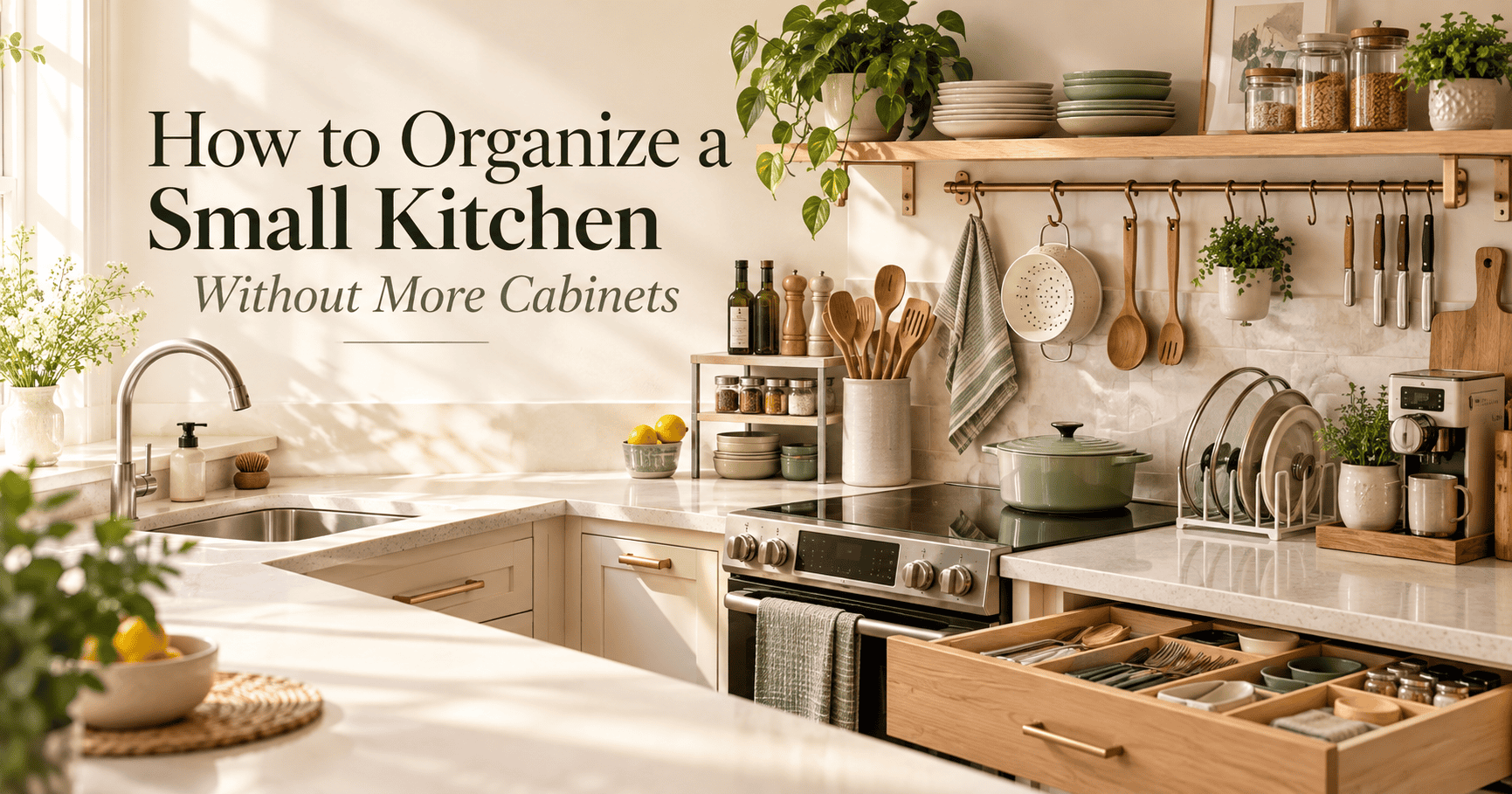
A small kitchen can feel crowded surprisingly fast. A few appliances on the counter, deep cabinets that are difficult to reach, overflowing drawers, and pantry items stored wherever they fit can make it seem like the only solution is adding more cabinets.
Fortunately, more cabinetry is not always necessary. The best way to organize a small kitchen is to make the storage you already have easier to see, reach, and maintain.
Before buying another cabinet or filling every empty corner with storage furniture, use the ideas below to reorganize your existing space. The goal is not to squeeze more belongings into the kitchen. It is to create a kitchen where the things you actually use have logical, accessible homes.
Use these ideas when you want more usable kitchen space without adding more cabinets.
To organize a small kitchen without adding cabinets, first clear the counters, remove duplicates, group items by function, and reserve your easiest-to-reach storage for things you use most often. Then improve awkward areas with vertical storage, better drawer divisions, pull-forward containers, and carefully chosen wall or door storage.
For a broader overview of the entire room, visit our Small Kitchen Organization Guide, which brings together practical strategies for cabinets, counters, cookware, pantry storage, renters, and under-sink areas.
Start Here Before Reorganizing a Small Kitchen
One of the easiest mistakes is assuming that a storage problem automatically requires more storage.
Sometimes the kitchen already has enough capacity, but that capacity is being used inefficiently.
Identify What Is Actually Creating the Clutter
Look at your kitchen before moving anything and identify the areas that cause the most frustration.
For example:
- Are the countertops crowded with appliances?
- Do pots have to be removed to reach the pan you need?
- Are food-container lids constantly falling over?
- Can you see what is stored at the back of deep cabinets?
- Are pantry ingredients spread across several unrelated locations?
- Are everyday items stored above or behind things you rarely use?
Those answers tell you which problems actually need solving.
Separate Everyday Items From Occasional Items
Not every kitchen item deserves the same amount of accessibility.
Items used every day should normally occupy the easiest drawers, shelves, and cabinets. Equipment used only occasionally can usually move higher, lower, farther back, or to another appropriate storage area.
Small-kitchen rule: Give your best storage space to the things you use most—not necessarily the things that take up the most room.
12 Ways to Organize a Small Kitchen Without Adding More Cabinets
1. Create One Completely Clear Prep Zone
Counter space is especially valuable in a small kitchen because it serves as working space.
Choose one section of counter as your primary preparation zone and remove anything that does not need to live there.
This may mean relocating decorative pieces, rarely used appliances, mail, grocery bags, backup supplies, or utensils that have gradually accumulated on the counter.
Why it helps: Even if you do not gain an inch of new storage, having one reliable work surface can make the entire kitchen feel more functional.
2. Build Storage Around Kitchen Tasks
Instead of asking, “Where can this fit?” ask, “Where do I use this?”
Group items around common tasks:
- Prep zone: cutting boards, knives, and mixing tools.
- Cooking zone: pots, pans, cooking utensils, and frequently used seasonings.
- Dish zone: everyday plates, bowls, glasses, and mugs.
- Cleaning zone: dish soap, sponges, dishwasher supplies, and cleaning essentials.
- Beverage zone: coffee, tea, mugs, and frequently used accessories.
This reduces unnecessary movement and prevents similar items from being scattered across multiple cabinets.
3. Use the Full Height of Cabinet Shelves
Open a cabinet and look above the items on each shelf.
If short bowls, mugs, cans, or containers occupy only the lower half of a tall shelf, you may have usable vertical space.
Rearranging shelf heights, when your cabinetry allows it, can help. A suitable shelf riser may also create another level for shorter items.
Extra levels are useful only when everything remains easy to remove. Avoid creating stacks that require unloading several items every time you need something underneath.
4. Stop Treating Deep Cabinets Like Regular Shelves
A deep cabinet may technically hold plenty of items while still being frustrating to use. The problem is often visibility rather than capacity.
Group smaller items into removable containers or categories that can be pulled forward together. This lets you reach the back without removing everything stored in front.
This approach can work particularly well for baking supplies, snacks, food-storage supplies, and cleaning products.
5. Divide Drawers According to Function
A large drawer does not automatically provide useful storage. Without divisions, small utensils can mix together and consume more space than necessary.
Start by removing duplicates and tools you rarely use. Then group what remains by function.
- Everyday cutlery
- Cooking utensils
- Food-preparation tools
- Baking tools
- Wraps and food-storage supplies
Use existing containers to test the arrangement before purchasing drawer dividers.
6. Store Pot and Container Lids Vertically
Lids can consume a surprising amount of cabinet space when stacked horizontally.
When the cabinet layout allows it, storing lids vertically can make individual pieces easier to identify and remove.
You can test the idea using an appropriate rack or divider you already own before deciding whether a dedicated organizer is necessary.
7. Reduce Food-Storage Container Clutter
Take every food-storage container and lid out at the same time.
Match the pieces. Containers without useful lids and lids without matching containers create clutter without providing usable storage.
Once the set has been simplified, nest compatible containers where practical and keep lids in a defined section.
8. Use Cabinet Doors Only When They Solve a Real Problem
The inside of some cabinet doors can provide useful storage for lightweight, shallow items. However, this space should not automatically be filled.
Door storage may be useful for small measuring tools, lightweight cleaning accessories, wraps, or other shallow items when there is sufficient clearance.
Check the available width, depth, hinges, shelves, plumbing, and handles. Close the door slowly before permanently attaching anything to confirm that the organizer and its contents will clear everything inside.
9. Use Wall Space Selectively
Walls can provide additional organization without adding cabinetry, but covering every available surface can make a small kitchen feel visually crowded.
Hooks, rails, or shallow shelves are most useful when they hold items that are frequently needed and appropriate for visible storage.
Good wall storage should improve access without interfering with cooking surfaces, electrical outlets, ventilation, doors, or walking areas.
10. Create a Dedicated Small-Appliance Zone
Small appliances are common countertop clutter creators.
Decide which appliances genuinely need immediate access. A coffee maker used every morning may deserve counter space, while a specialty appliance used a few times per month may be better stored elsewhere.
Grouping occasional appliances together also prevents them from occupying several unrelated cabinets.
11. Use Narrow Gaps Carefully
Some kitchens have narrow unused spaces beside cabinets or compatible appliances.
A slim storage solution can sometimes make those gaps useful, but not every empty space needs to be filled.
Never block appliance ventilation, utility access, doors, drawers, walkways, or areas needed for cleaning. Check appliance manufacturer clearance requirements before placing storage directly beside an appliance.
12. Leave Some Storage Space Empty
This may sound strange in a small kitchen, but completely full cabinets are difficult to maintain.
Your kitchen needs enough flexibility to handle groceries, temporary leftovers, changing pantry supplies, and new household needs.
A little unused capacity can be more valuable than fitting one more item onto every shelf.
Remember: The goal is not maximum storage density. The goal is a kitchen that stays functional during everyday life.
How to Organize a Small Kitchen by Zone
Once unnecessary items have been removed, organize what remains according to where each activity happens.
| Zone | Keep Here | Consider Moving |
|---|---|---|
| Prep Area | Knives, cutting boards, mixing and prep tools | Decor and rarely used appliances |
| Cooking Area | Frequently used pots, pans, utensils, and seasonings | Specialty cookware used occasionally |
| Sink Area | Daily dishwashing and cleaning essentials | Bulk cleaning backstock |
| Dish Storage | Everyday plates, bowls, mugs, and glasses | Special-occasion serving pieces |
| Pantry Area | Frequently used foods grouped by category | Excess duplicates and expired items |
| Beverage Area | Daily coffee or tea essentials | Unrelated countertop items |
How to Make Small Kitchen Cabinets Work Harder
Upper Cabinets
Use the easiest-to-reach shelves for lightweight items that are used frequently, such as everyday dishes, glasses, mugs, or common pantry ingredients.
Higher shelves are better suited to lighter items that are needed less often.
Lower Cabinets
Lower cabinets can be practical for heavier cookware, pots, pans, appliances, and larger containers.
If the cabinet is deep, prioritize systems that let you bring items forward rather than creating multiple hidden rows.
Corner Cabinets
Corner cabinets can offer substantial capacity but poor accessibility.
Instead of filling every inch, dedicate the cabinet to one or two categories. A removable bin or suitable turntable can help in some layouts, but only if it improves access.
Under the Sink
The cabinet under the kitchen sink has unique limitations because plumbing and the garbage disposal, when present, interrupt the usable space.
Keep plumbing visible and accessible, avoid overcrowding the cabinet, and measure around pipes before adding storage.
For more help with this awkward area, see our guide to the best under-sink organizers for kitchens.
How to Keep Small Kitchen Counters Clear
Use the Daily-Use Test
Ask how often you use every appliance or object currently sitting on the counter.
Items used daily are stronger candidates for permanent counter space. Everything else should earn its place based on how difficult it would be to retrieve and store.
Contain Small Groups
If several small items need to remain visible, grouping them can make the counter easier to maintain.
For example, frequently used cooking oils or coffee supplies can occupy one defined area instead of spreading across the entire work surface.
Move Non-Kitchen Clutter Elsewhere
Mail, keys, receipts, chargers, paperwork, and shopping bags often land in the kitchen simply because the counter is convenient.
If possible, give these items a dedicated home outside your primary kitchen work zones.
Try This Before Buying Anything
You can make significant changes to a small kitchen without purchasing a single organizer.
Try this reset first:
- Clear the main countertops.
- Remove expired food and unnecessary duplicates.
- Match food-storage containers with their lids.
- Group similar kitchen tools together.
- Move rarely used items out of prime storage.
- Place frequently used items near the task they support.
- Nest compatible bowls, cookware, and containers.
- Test vertical lid storage using something appropriate you already own.
- Use existing baskets, boxes, or trays temporarily to test categories.
- Leave some cabinet and pantry capacity open.
Use your reorganized kitchen for about a week before buying storage products. Pay attention to the places that still slow you down. Those recurring problems—not empty spaces—are what a future organizer should solve.
Before Buying Kitchen Organizers
If a storage problem remains after the reset, measure before choosing an organizer.
For Cabinet Organizers
- Measure usable interior width.
- Measure usable depth.
- Measure shelf-to-shelf height.
- Account for hinges and door frames.
- Check whether the organizer can be removed when necessary.
For Under-Sink Storage
- Measure around pipes.
- Account for the garbage disposal if present.
- Check the door opening.
- Keep shutoff valves and plumbing accessible.
For Over-the-Door Storage
- Measure door thickness.
- Check clearance above the door.
- Measure available depth behind the door.
- Make sure the organizer will not hit shelving or another wall.
If unused door space could help your kitchen or pantry, our over-the-door organizer guide explains the main fit considerations.
Before buying: Measure the space and the items you intend to store. An organizer that technically fits the cabinet can still be a poor choice if it reduces access or wastes usable space.
7 Common Small Kitchen Organization Mistakes
1. Buying Organizers Before Decluttering
New containers cannot solve an excess of duplicate utensils, expired pantry products, unused appliances, or mismatched storage containers.
2. Filling Every Empty Space
Not every wall, gap, cabinet door, and countertop corner needs storage.
Visual and physical breathing room helps a small kitchen remain comfortable to use.
3. Storing Rarely Used Items in Prime Locations
Special-occasion dishes and specialty equipment should not make everyday items difficult to reach.
4. Creating Too Many Tiny Categories
An organization system should be easy to maintain. Broad categories such as baking, snacks, breakfast, or food storage are often more sustainable than dozens of highly specific groups.
5. Ignoring Accessibility
More items fitting inside a cabinet does not automatically mean the cabinet is better organized.
If you must remove three things to reach a fourth, reconsider the arrangement.
6. Letting Countertops Become Permanent Storage
A small kitchen loses functionality quickly when its main work surfaces become shelves for appliances and miscellaneous objects.
7. Forgetting About Maintenance
The best system is one that can survive normal grocery trips, cooking, cleaning, and busy days.
If returning an item to its designated place requires too many steps, simplify the system.
What If the Pantry Is the Main Problem?
A crowded pantry can make the entire kitchen feel disorganized even when the cabinets are functioning well.
Start by grouping foods into practical categories, keeping frequently used ingredients accessible, and avoiding unnecessary layers that hide products behind each other.
For a deeper pantry reset, see 15 Small Pantry Organization Ideas That Make the Most of Every Inch.
Final Small Kitchen Organization Checklist
- Is there at least one clear food-preparation area?
- Are everyday items in easy-to-reach locations?
- Are similar items stored together?
- Can you reach items at the back of deep cabinets?
- Are food-container lids easy to find?
- Have rarely used appliances been moved out of prime space?
- Is under-sink plumbing still accessible?
- Are counters free from unrelated household clutter?
- Have you avoided filling every available gap?
- Is there some flexible storage capacity left?
Frequently Asked Questions
How do I organize a small kitchen with very little cabinet space?
Start by reducing duplicates and moving rarely used items away from prime storage. Keep everyday items near the tasks they support, use cabinet height where it improves accessibility, organize deep cabinets into pull-forward categories, and preserve clear countertop work space.
How can I create more kitchen storage without adding cabinets?
Look for underused vertical space inside cabinets, suitable wall or door space, deep shelves that could work better with pull-forward storage, and drawers that need better divisions. Reorganizing existing belongings can also recover storage without adding anything new.
How can I organize a small kitchen without buying anything?
Clear the counters, remove unnecessary duplicates, group similar items, relocate rarely used equipment, nest compatible containers and cookware, and test categories with boxes, baskets, or trays you already own.
What should stay on a small kitchen counter?
Prioritize items you use frequently and that genuinely benefit from immediate access. Try to preserve at least one clear area for food preparation rather than using every part of the counter for permanent storage.
How do you organize deep kitchen cabinets?
Group smaller items into removable or pull-forward categories so you can access the back of the cabinet without unloading everything in front. Avoid creating several hidden rows of unrelated items.
How should pots and pans be organized in a small kitchen?
Keep the cookware you use most often near the cooking area, nest compatible pieces when practical, and consider storing lids vertically if that makes individual pieces easier to access.
Is open shelving good for a small kitchen?
It can be useful for frequently used items, but open storage also adds visual exposure and requires regular maintenance. It works best when it solves a specific access problem rather than simply adding another place to store clutter.
Should I buy organizers for every kitchen cabinet?
No. Add an organizer only when it solves a specific problem such as unused vertical space, difficult access, or small items that continually mix together. Some cabinets function better with simple open space.
Final Thoughts
You do not necessarily need a bigger kitchen—or another row of cabinets—to make a small kitchen easier to use.
Start with the storage you already have. Clear the counters, move occasional items away from prime locations, group belongings around the tasks they support, and make awkward cabinets easier to access.
Then live with the new arrangement before adding more storage products.
A well-organized small kitchen is not the kitchen that holds the most things. It is the kitchen where the things you actually use are easy to find, easy to reach, and easy to put away.