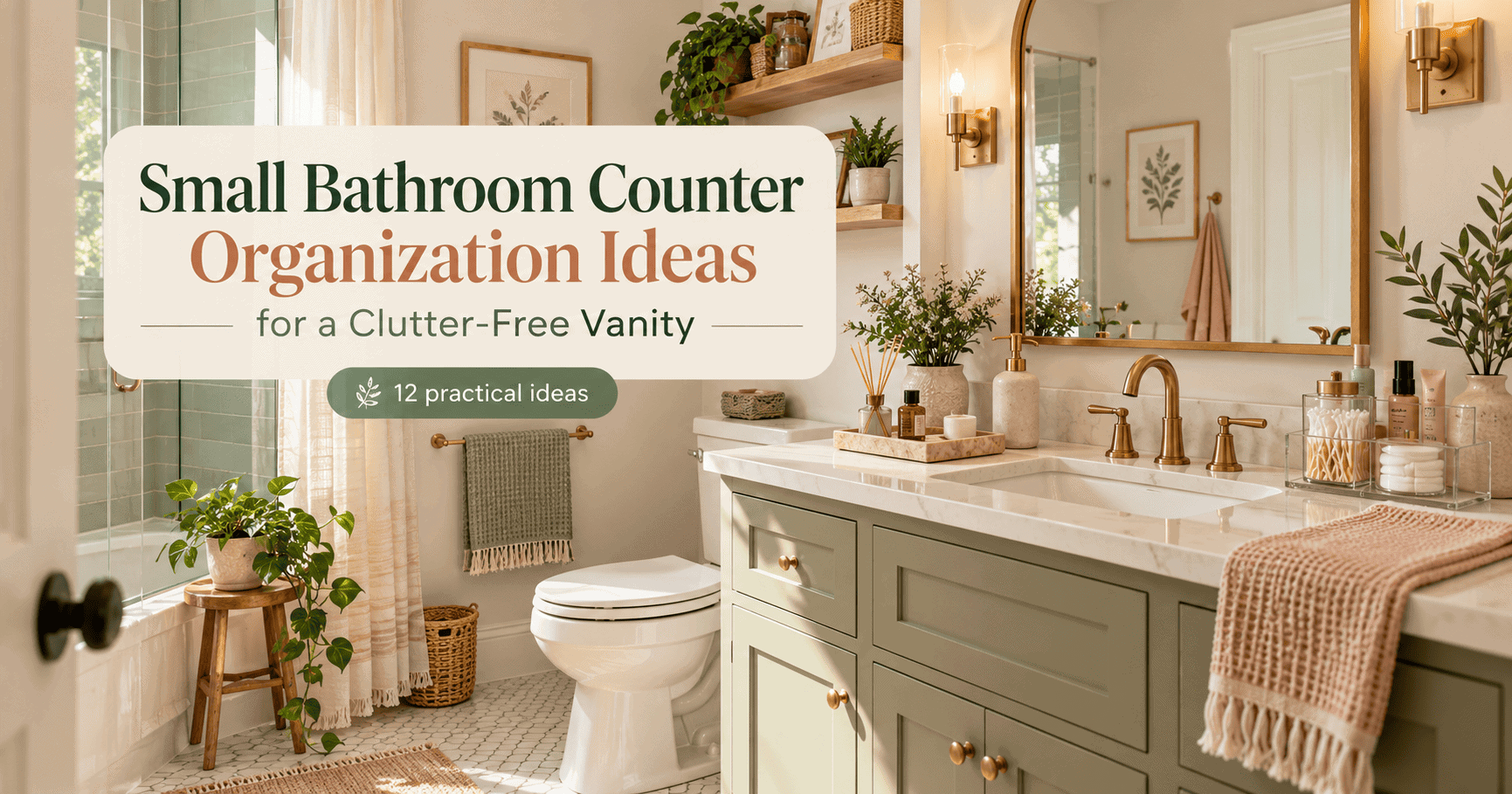
The goal is not to make the counter completely empty. It is to keep daily essentials easy to reach while preserving enough open space for washing, grooming, cleaning, and getting ready comfortably.
Keep these small bathroom counter organization ideas handy for vanities, skincare, makeup, grooming products, sink areas, and other compact bathroom surfaces.
Quick Answer: How to Organize a Small Bathroom Counter
- Remove products that are empty, expired, duplicated, or rarely used.
- Keep only true daily-use essentials on the vanity.
- Group visible products into one or two defined zones.
- Move backups into drawers, cabinets, or another storage area.
- Protect open space around the sink and faucet.
- Add a tray or organizer only if it reduces clutter rather than creating more of it.
If your counter is only one part of a larger storage problem, start with our small bathroom organization guide for cabinets, drawers, under-sink storage, towels, toiletries, walls, doors, renters, and other compact bathroom areas.
Clear the Counter Before You Organize It
It is difficult to organize a crowded vanity while everything is still sitting on it. Start by removing all movable products from one section of the counter.
Discard empty or unusable products
Remove empty packaging, products you no longer use, and anything that should be discarded according to the product label or applicable disposal guidance.
Separate daily-use items from occasional items
Products used every morning or evening deserve easier access than masks, specialty treatments, backup toothpaste, extra soap, or other occasional supplies.
Move duplicates and backups away from prime space
A vanity counter is valuable because it supports your daily routine. Unopened replacements usually do not need to occupy that space.
Create Simple Zones on a Small Bathroom Vanity
A few clear zones can make a small counter easier to maintain than several scattered collections of products.
Simple zones for organizing a small bathroom counter
| Zone | Good Items to Keep There | What to Avoid |
|---|---|---|
| Sink zone | Soap and one or two daily essentials | Backup bottles and unrelated products |
| Daily routine zone | Frequently used skincare or grooming items | Occasional treatments and unopened backups |
| Small-item zone | Hair ties, cotton pads, or similar essentials | Large collections of tiny containers |
| Open work zone | Mostly empty counter space | Permanent storage products |
12 Small Bathroom Counter Organization Ideas
1. Keep Only Daily Essentials Visible
Start with the products you genuinely use almost every day. A small counter becomes easier to maintain when occasional items live somewhere else.
2. Use One Small Tray for a Daily Routine
A tray can visually contain a few products so they read as one intentional group instead of scattered clutter.
3. Leave Space Around the Sink
Soap, water, grooming tools, and personal-care products can quickly crowd the faucet area. Keep enough open space for washing hands, brushing teeth, and cleaning the vanity.
4. Move Backup Products Into a Cabinet or Drawer
Unopened soap, toothpaste, skincare, cosmetics, and personal-care products usually do not need immediate access.
If the cabinet below the vanity is difficult to use, see our guide on how to organize under the bathroom sink without wasting space around plumbing.
5. Group Products by Routine Instead of Category
Instead of storing every skincare product together, think about how you actually use the counter. A morning routine zone and an evening routine zone may be easier to maintain than many small product categories.
6. Use Clear Storage Only When Visibility Helps
Clear organizers can make small products easier to identify, but they are most useful when you need visibility. They are not automatically better than drawers, bins, or trays.
7. Keep Hair Tools Off the Counter When Possible
Hair dryers, curling tools, brushes, and styling products can occupy a large amount of vanity space. Store them in a drawer, cabinet, basket, or another suitable location when they are not being used.
8. Give Small Loose Items One Defined Home
Hair ties, clips, cotton pads, floss picks, and similar items can make a counter look cluttered even when they occupy little space.
Use one compact container, drawer section, or other defined location instead of several separate jars.
9. Keep Decorative Items Minimal
Decor can make a bathroom feel inviting, but on a very small vanity every object competes with useful workspace.
10. Use Vertical Storage Carefully
A narrow tiered organizer may help when several short products need to stay visible, but it should not block the mirror, outlet, faucet, cabinet door, or normal cleaning access.
11. Keep Shared Products in the Middle
In a shared bathroom, products used by more than one person may work better in a neutral central location while personal products remain in drawers, cabinets, or separate zones.
12. Protect One Section of Counter as Open Space
Not every inch of a small vanity needs storage. Leaving one area intentionally empty gives you room to set down a toiletry bag, apply products, clean the counter, or complete your routine without moving several items first.
What Should Stay on a Small Bathroom Counter?
There is no universal list, but the best candidates are items used so frequently that putting them away would make your routine unnecessarily inconvenient.
Depending on your household, that may include:
- Hand soap.
- A toothbrush holder or other frequently used dental item.
- A small number of daily skincare products.
- One frequently used grooming item.
- A compact tray for a consistent morning or evening routine.
- One small container for loose essentials when needed.
If the counter begins to feel crowded again, reduce the number of visible products before adding another organizer.
What Should Move Off the Bathroom Counter?
Items that are rarely used, bulky, duplicated, or easy to store nearby are usually better candidates for drawers or cabinets.
Unopened backups
Extra soap, toothpaste, cosmetics, skincare, and similar products do not need prime counter space.
Occasional treatments
Masks, specialty grooming products, styling tools, and other occasional items can usually be stored away until needed.
Large product collections
If several similar bottles or containers are visible, keep the products in active use and move the rest into a defined backup area.
Items that belong to another room or task
Mail, clothing, household supplies, and unrelated objects should not become permanent vanity storage simply because the counter is convenient.
Ideas for a Very Small Bathroom Vanity
If the vanity has only a narrow strip of counter around the sink, focus on access rather than trying to create multiple storage zones.
Choose one visible category
Keep only one compact group of daily products on the counter and store everything else nearby.
Use the drawer before adding more countertop storage
If a drawer has unused space, organizing it may free more counter area than adding another tray or tiered stand.
Use the cabinet below before adding furniture
Under-sink storage may provide enough room for backups, toiletries, or grooming products once it is divided into practical zones.
Avoid oversized accessories
Large trays, decorative jars, tiered stands, and baskets can overwhelm a narrow vanity even when they are technically able to fit.
Before Buying a Bathroom Counter Organizer
Do not buy a countertop organizer simply because the vanity looks cluttered. First determine which specific problem remains after removing unnecessary items.
- Usable counter width and depth.
- Clearance around the faucet and sink basin.
- Distance from the counter to the mirror or medicine cabinet.
- Nearby outlet and switch locations.
- Door, drawer, or cabinet movement.
- The dimensions of the products you actually want to store.
Compare trays when you need containment
A small tray can work well for a few daily products when the main problem is visual clutter rather than a lack of capacity.
Compare clear organizers when visibility matters
Acrylic or clear organizers may help when small products are difficult to identify or frequently get lost inside drawers or cabinets.
Compare tiered organizers only when vertical space is useful
A tiered design can make sense if it uses height without blocking other fixtures or making the counter harder to clean.
If you want to compare broader bathroom storage categories, our 10 Amazon Bathroom Organization Finds guide covers countertop trays, clear organizers, under-sink bins, shower caddies, vertical storage, and other options.
A 5-Minute Bathroom Counter Reset
A small vanity can stay organized with a short reset instead of frequent full reorganizations.
- Put away anything that does not belong on the counter.
- Return daily-use products to their assigned zone.
- Move backup or occasional products into drawers or cabinets.
- Remove empty packaging.
- Wipe the open counter and sink area.
- Leave one section of the vanity intentionally clear.
Frequently Asked Questions
How do I organize a small bathroom counter?
Remove rarely used products, keep only daily essentials visible, group those items into one or two compact zones, move backups into drawers or cabinets, and preserve open space around the sink.
What should I keep on my bathroom vanity?
Keep only products used frequently enough to justify immediate access, such as hand soap, dental essentials, a few daily skincare products, or one compact routine tray.
How can I make a bathroom counter look less cluttered?
Reduce the number of visible products, move backups off the counter, use one defined tray or container when needed, and leave part of the surface intentionally empty.
Are bathroom counter trays useful?
They can be useful when they contain a small number of frequently used products. A tray is less helpful if it becomes a place to collect unrelated items or encourages more products to remain visible.
How do I organize skincare on a small bathroom counter?
Keep only the products used in your current routine on the counter and move backups or occasional treatments elsewhere. Grouping the active products into one small zone can reduce visual clutter.
How do I organize a bathroom counter without buying anything?
Remove products you rarely use, relocate backups, group remaining items by routine, reuse a small tray or container you already own, and protect one section of the counter as open workspace.
What if I have almost no bathroom counter space?
Keep only the most essential visible items, use drawers and cabinets first, avoid oversized accessories, and consider whether under-sink or wall storage can hold products that do not need to remain on the vanity.
This guide focuses on practical, reader-first organization strategies for small bathroom counters and vanities. It does not claim that one storage product works for every bathroom. Always measure your specific counter and verify product dimensions, materials, cleaning requirements, compatibility, seller information, price, and return terms before purchasing.
Final Thoughts
A clutter-free bathroom counter is less about finding room for every product and more about deciding what truly deserves to stay visible.
Keep daily essentials easy to reach, move backups and occasional products into nearby storage, use one or two simple zones, and protect open space around the sink.
The most useful small bathroom vanity is not the one with the most organizers—it is the one that gives you enough room to complete your routine comfortably.