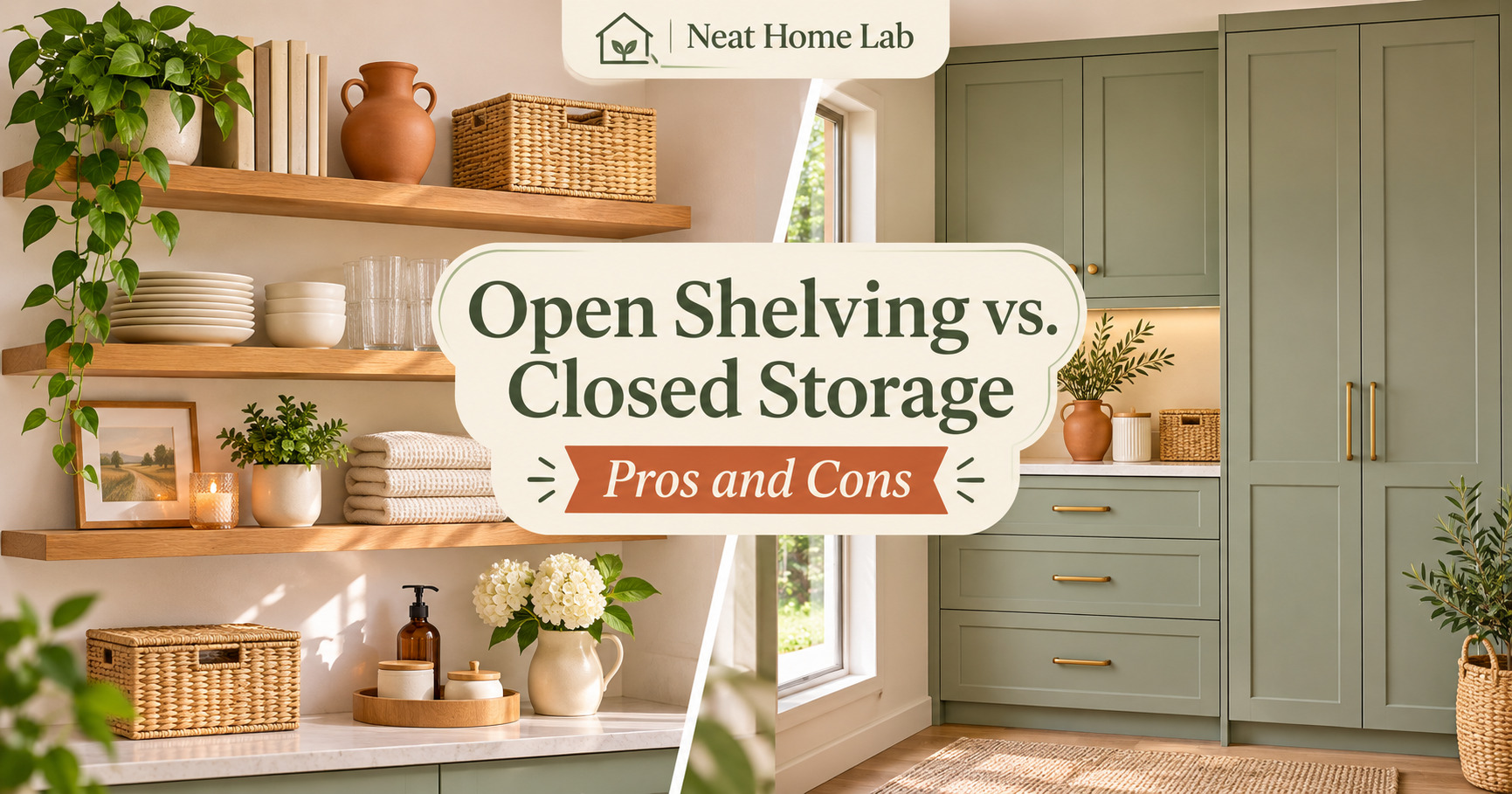
Open shelving and closed storage solve different organization problems. Open shelves are usually better when visibility and quick access matter most, while closed cabinets, drawers, and storage units are often better when you want to reduce visual clutter and keep belongings more protected.
For many homes, the most practical solution is not choosing one over the other. A mix of open and closed storage can keep everyday items easy to reach while hiding backups, paperwork, electronics, toys, and visually busy categories.
Keep this guide handy when planning kitchens, bathrooms, living rooms, bedrooms, entryways, and small-space storage.
Quick Answer: Open Shelving vs. Closed Storage
- Choose open shelving when you want frequently used items visible and easy to reach.
- Choose closed storage when hiding visual clutter is more important.
- Open shelving usually requires more frequent dusting and visual maintenance.
- Closed storage can make a room look calmer, but stored items may be easier to forget.
- Measure available wall, floor, cabinet, and door space before choosing furniture or shelving.
- A combination of open and closed storage often provides the best balance.
Open Shelving: Best for Visibility and Quick Access
Open shelving keeps belongings visible and accessible without doors or drawers. It can work well for items that are used frequently enough to justify being on display.
Best for Everyday Items
Frequently used dishes, mugs, towels, books, baskets, cookbooks, plants, and decorative objects can be convenient on open shelves because you can see and reach them immediately.
Can Make Small Areas Feel Lighter
Open shelves often have less visual bulk than large closed cabinets, especially when the shelves are not overcrowded. This can help a wall feel more open.
Useful When You Want to See What You Own
Visibility can reduce searching and make it easier to notice when a category becomes overcrowded or needs to be restocked.
- You use the stored items frequently.
- Visibility makes your routine easier.
- You are comfortable keeping the shelf visually tidy.
- The items are relatively easy to clean.
- You want storage without the visual weight of a large cabinet.
Closed Storage: Best for Reducing Visual Clutter
Closed storage includes cabinets, cupboards, drawers, wardrobes, storage benches, and other units that keep contents behind doors or fronts.
Best for Visually Busy Categories
Electronics, paperwork, toys, backup toiletries, food packages, cleaning supplies, seasonal items, and mixed household categories can make a room feel cluttered when everything remains visible.
Useful for Less Frequently Used Items
Closed storage can work well for belongings that need a home but do not require constant access.
Can Create a Calmer Look
Doors and drawers can reduce visual noise because the individual shapes, colors, labels, and packages inside are hidden from view.
- You want to conceal visual clutter.
- The category contains many different colors, packages, or shapes.
- The items are not needed constantly.
- You prefer a simpler room appearance.
- You want more separation between displayed items and everyday storage.
Open Shelving vs. Closed Storage: Side-by-Side Comparison
| Priority | Open Shelving | Closed Storage |
|---|---|---|
| Quick visibility | Strong choice | Requires opening doors or drawers |
| Fast access | Strong choice | Still convenient but less immediate |
| Hide visual clutter | Limited | Strong choice |
| Dust exposure | More exposed | Generally more protected |
| Display decorative items | Strong choice | Limited unless doors are glass |
| Store mixed categories | Can look busy | Often easier visually |
| Visual maintenance | Usually higher | Usually lower from outside |
| Remember what you own | Easy because contents are visible | May require labels or regular review |
| Small-space flexibility | Can feel lighter | Can hide clutter effectively |
Visibility and Accessibility
Open Shelving Keeps Items in Sight
If you tend to forget what is stored behind cabinet doors, open shelves can make everyday categories easier to manage.
This can be useful for dishes, towels, books, baskets, pantry containers, or frequently used household items.
Closed Storage Reduces What You See
Closed cabinets can create a cleaner appearance, but they may require better internal organization because the contents are hidden.
Dust and Cleaning
Open shelves and the objects on them remain exposed to normal household dust, so they may require more regular cleaning.
Open Shelves
Open surfaces are easy to see when they need cleaning, but every object may need to be moved or wiped individually depending on the setup.
Closed Cabinets and Drawers
Closed storage can reduce some direct dust exposure, although cabinet interiors still require periodic cleaning and decluttering.
Think About What You Are Storing
Frequently washed dishes or towels may be easier to maintain on open shelves than decorative objects or rarely used items that collect dust over time.
Visual Clutter and Room Style
Open Shelving Needs Editing
Open shelves usually look calmer when they are not filled edge to edge. Limiting categories, repeating similar containers, and leaving some open space can help.
Closed Storage Is More Forgiving
Closed storage allows different colors, packaging, shapes, and categories to remain together without becoming part of the room’s visual appearance.
Use Baskets on Open Shelves When Needed
Baskets or bins can provide a middle ground by keeping the shelf open while concealing small or visually busy items.
Space Efficiency
Neither storage style is automatically more space-efficient. The better option depends on the room layout and what needs to be stored.
Open Shelving Can Use Empty Wall Space
Wall-mounted shelves can add storage without occupying much floor space, but they still need appropriate support and safe installation.
Closed Storage Can Hold More Mixed Items
Cabinets and drawers can make it easier to use deep or tall storage areas for belongings that would look cluttered on an open shelf.
Do Not Ignore Door Clearance
Closed cabinets need space for doors or drawers to open. In narrow rooms, sliding, drawer-based, or open storage may sometimes be easier to use.
Open or Closed Storage? Best Option by Room
Kitchen
Open shelving can work well for frequently used dishes, mugs, cookbooks, or attractive containers.
Closed storage is often better for appliances, food packages, cleaning supplies, mismatched cookware, and visually busy categories.
Bathroom
Open shelving can be useful for towels, baskets, and a small number of daily products.
Closed cabinets are useful for backup toiletries, personal-care items, cleaning supplies, and categories you prefer to keep out of sight.
Living Room
Open shelves work well for books, plants, framed photos, decorative objects, and a limited number of baskets.
Closed storage can be better for electronics, cables, paperwork, toys, games, and miscellaneous household items.
Bedroom
Open storage can work for books, decor, baskets, or carefully selected accessories.
Closed storage is often easier for clothing, personal items, laundry-related supplies, and visually mixed categories.
Entryway
Open hooks and shelves can help with frequently used coats, bags, keys, or shoes.
Closed storage can reduce clutter when the entryway contains many shoes, seasonal accessories, pet supplies, or household extras.
Home Office
Open shelving is useful for books, frequently used supplies, or decorative storage boxes.
Closed cabinets or drawers can be better for paperwork, electronics, cables, office supplies, and categories that quickly create visual noise.
The Best Mix: Open and Closed Storage Together
Many rooms benefit from using both storage styles instead of choosing only one.
Keep Everyday Items Open
Frequently used objects can remain on shelves, hooks, or open cubbies where they are easy to see and return.
Hide Backups and Visually Busy Items
Extra supplies, seasonal belongings, paperwork, mixed packaging, and infrequently used items can go behind doors or inside drawers.
Use Open Storage Above and Closed Storage Below
A common approach is to keep lighter visual storage at eye level while using lower cabinets or drawers for less attractive categories.
Use Baskets as a Middle Ground
Baskets on open shelving can provide quick access while hiding small or mixed items from view.
When Open Shelving May Not Work Well
Open shelving can become difficult to maintain when too many unrelated items share the same surface or when the objects are rarely used and collect dust.
It May Feel Cluttered
Colorful packaging, cables, paperwork, toys, and mixed household items can quickly create visual noise.
It Requires More Visual Discipline
If you prefer to place items away quickly without arranging them, closed storage may be easier to maintain.
It Is Not Ideal for Every Category
Some belongings benefit from more protection, privacy, or separation than an open shelf provides.
When Closed Storage May Not Work Well
Closed cabinets and drawers can hide clutter so effectively that items become forgotten or duplicated.
Deep Cabinets Can Reduce Visibility
Items at the back may be difficult to see unless shelves, drawers, bins, or pull-out systems improve access.
Doors Need Clearance
Cabinet doors and drawers require room to open, which can be inconvenient in narrow walkways or tight corners.
It Can Encourage Overfilling
Because contents are hidden, it can be easy to continue adding items until the cabinet becomes difficult to use.
Try This Before Buying New Storage
You can also use baskets, boxes, or furniture you already own to test the layout before purchasing a larger storage unit.
Amazon Shopping Checklist
- Identify what you need to store.
- Decide whether visibility or concealment is more important.
- Measure usable wall, floor, shelf, or cabinet space.
- Check door, drawer, walkway, and furniture clearance.
- Review materials and care requirements.
- Check stated weight capacity when relevant.
- Review assembly and installation requirements.
- Make sure frequently used items will remain easy to reach.
- Verify the current Amazon listing before purchasing.
Affiliate disclosure: As an Amazon Associate I earn from qualifying purchases. The Amazon link below is a paid affiliate link.
Compare Open Shelving and Storage Organizers
Open shelves, storage cubes, baskets, cabinets, and other organization products can be combined to create a balance between visible everyday storage and concealed categories.
Consider open storage if: You want frequently used items visible and easy to reach.
Consider closed storage if: Your main goal is reducing visual clutter and keeping mixed categories out of sight.
- Compare exact exterior dimensions.
- Check usable shelf or cabinet dimensions.
- Review material and care information.
- Check weight-capacity information when applicable.
- Review assembly or installation requirements.
- Check door and drawer clearance for closed units.
- Verify all current product information before purchasing.
View on Amazon(paid link)
This link opens Amazon search results rather than one tested or ranked product. Check the exact listing, dimensions, materials, stated weight capacity, installation requirements, care instructions, current price, seller information, and return terms before ordering.
Common Storage Planning Mistakes
Choosing Only by Appearance
A shelf or cabinet can look attractive but still be inconvenient if it does not match the way you use the room.
Putting Rarely Used Items on Open Shelves
Items that are rarely touched may collect dust and take up visible space that could be used for more practical storage.
Hiding Everyday Items Too Deeply
Frequently used belongings should not require opening several doors or moving other containers every time they are needed.
Overfilling Open Shelves
Open storage needs some breathing room to remain easy to use and visually manageable.
Overfilling Closed Cabinets
Closed storage still needs internal organization. A cabinet packed edge to edge can become just as difficult to use as a cluttered open shelf.
Ignoring Installation Requirements
Wall-mounted shelving and some storage furniture may require specific hardware, support, anchoring, or assembly. Review the manufacturer’s instructions before installation.
Frequently Asked Questions
Is open shelving better than closed storage?
Neither option is always better. Open shelving is often more useful for visibility and quick access, while closed storage is better when reducing visual clutter is the priority.
Does open shelving require more maintenance?
Usually it requires more visible maintenance because both the shelves and stored items remain exposed. How much cleaning is needed depends on the room, the items stored, and how often they are used.
Does closed storage keep items dust-free?
Closed storage can reduce direct dust exposure compared with open shelves, but it does not eliminate cleaning. Cabinet and drawer interiors still need periodic maintenance.
Which storage option is better for a small room?
It depends on the problem. Open shelving can feel visually lighter and use wall space, while closed storage can make a small room feel calmer by hiding clutter. A combination can often work best.
Can I combine open shelving and closed storage?
Yes. Keep everyday or attractive items visible and use cabinets, drawers, or closed bins for backups, paperwork, seasonal items, electronics, and visually busy categories.
What should I put on open shelves?
Open shelves are often useful for frequently used dishes, books, towels, baskets, plants, decorative pieces, or other categories that are practical to keep visible.
What should go in closed storage?
Closed storage can work well for paperwork, toys, electronics, cleaning supplies, backup toiletries, food packages, seasonal items, and other visually busy categories.
This comparison is intended to help you evaluate open shelving and closed storage according to visibility, access, visual clutter, cleaning, dust exposure, room placement, and maintenance. It does not represent hands-on testing or a claim that one storage style is always superior. Always verify the current Amazon listing, dimensions, materials, stated weight capacity, compatibility, installation requirements, care instructions, seller information, price, and return terms before purchasing.