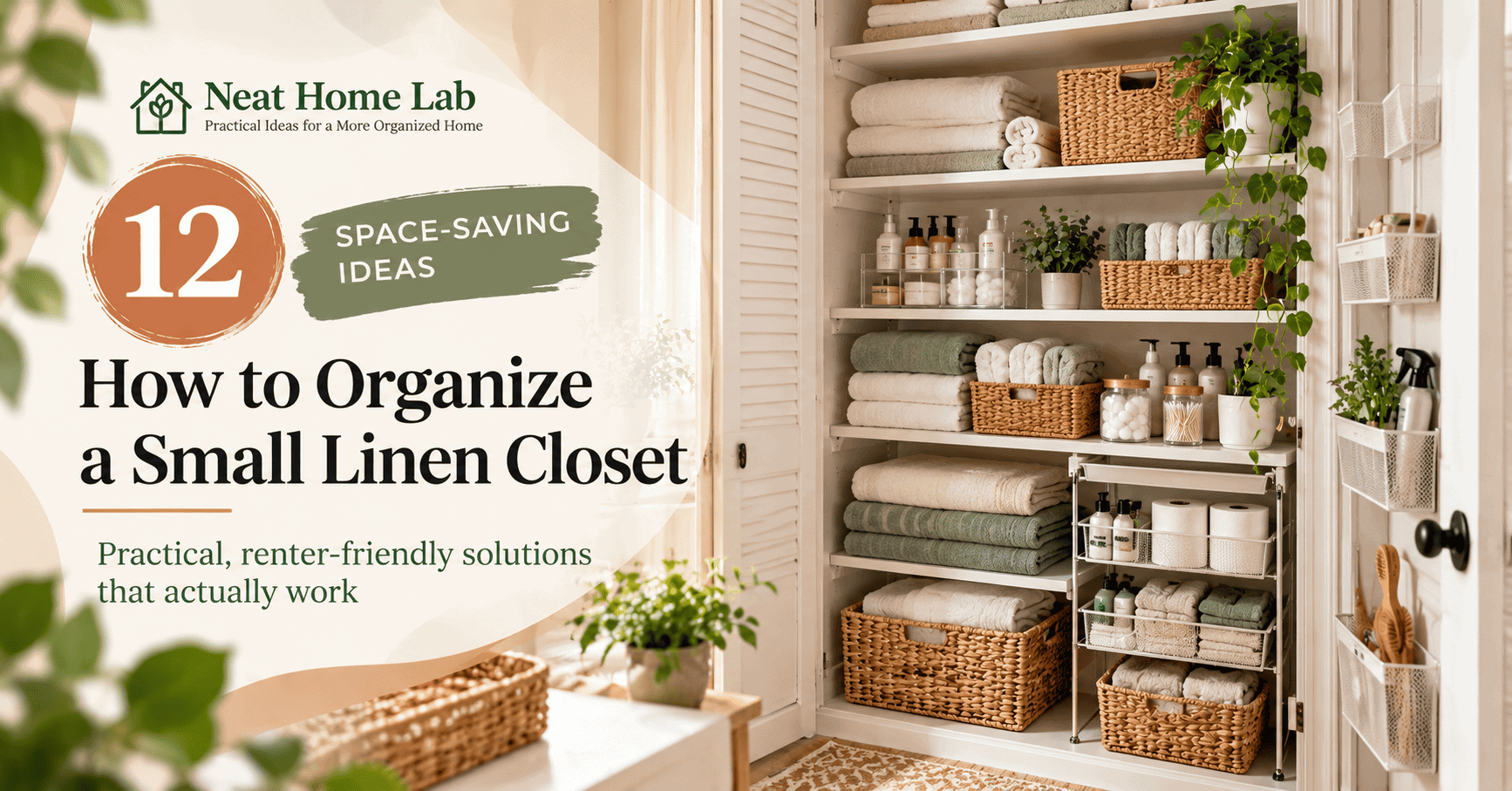
A small linen closet can become cluttered surprisingly fast. Towels get stacked too high, sheet sets separate from their matching pillowcases, toiletries disappear behind larger items, and extra supplies slowly take over every shelf.
The easiest way to organize a small linen closet is to create a few simple zones, keep everyday items at the easiest height, and use organizers only where they solve a specific problem.
You do not need a large closet or an expensive storage system. With a better layout, even narrow shelves can hold towels, bedding, toiletries, household supplies, and backstock without becoming difficult to maintain.
Keep these linen closet ideas handy for towels, sheets, toiletries, baskets, deep shelves, and small-space storage.
- Remove everything before deciding what storage products you need.
- Measure shelf width, depth, and vertical clearance before buying bins or dividers.
- Keep towels, sheets, toiletries, household supplies, and backstock in separate zones.
- Use vertical space only when it improves access.
- Keep frequently used items between waist and eye level when practical.
- Store backup supplies together instead of scattering duplicates throughout the closet.
- Leave some empty space so the system remains easy to maintain.
Quick Answer: What Is the Best Way to Organize a Small Linen Closet?
Divide the closet into a few broad zones: everyday towels, bedding, toiletries, household supplies, and backstock.
Keep the items used most often on the easiest-to-reach shelves, contain small or loose products in baskets or bins, and use shelf height only where it makes the space easier to access.
The goal is not to fit the maximum amount inside the closet. The goal is to make towels, bedding, and supplies easy to see, remove, and put back without disturbing everything around them.
Before You Organize: Empty, Measure, and Edit
Before buying organizers, take everything out of the closet. This gives you a realistic picture of what you own and prevents you from designing the storage around items you no longer need.
Measure the Usable Space
Measure the width and depth of every shelf as well as the vertical clearance between shelves.
Also check whether the door, hinges, trim, shelf supports, or closet opening reduce usable space. An organizer may fit the shelf dimensions but still be difficult to insert or remove through a narrow opening.
Reduce Unnecessary Duplicates
Pull out worn towels, incomplete sheet sets, expired toiletries, empty containers, and items that no longer serve a useful purpose.
The goal is not extreme minimalism. It is simply to avoid giving limited shelf space to items you do not use.
Group Similar Items Before Putting Anything Back
Create temporary groups for bath towels, hand towels, sheets, pillowcases, guest linens, toiletries, first-aid supplies, paper goods, cleaning supplies, and backstock.
Seeing each category together makes it easier to decide how much shelf space it actually deserves.
12 Small Linen Closet Organization Ideas
1. Create Clear Zones for Each Category
One of the biggest causes of linen closet clutter is mixing unrelated items on the same shelf.
Instead, assign a clear purpose to each area. One shelf might hold bath towels, another bedding, and another toiletries or household backstock.
A basket can create a smaller zone within a shelf for washcloths, guest towels, first-aid supplies, or other loose items.
Why it works: When every category has a defined home, putting items away requires less decision-making.
2. Keep Everyday Items at the Easiest Height
Use the most accessible shelves for the things your household reaches for most often.
For many homes, that means bath towels, hand towels, frequently used sheets, and basic toiletries.
Upper shelves can hold lightweight guest linens, seasonal blankets, or less frequently used supplies. Lower shelves can work for heavier backstock when the items remain easy to see and retrieve.
3. Fold Towels to Fit the Shelf
There is no single correct way to fold towels. The best fold is the one that fits your shelf dimensions and allows one towel to be removed without collapsing the rest of the stack.
On shallow shelves, a compact fold may work best. On deeper shelves, shorter stacks can prevent towels from disappearing toward the back.
4. Keep Each Sheet Set Together
Sheet sets are easier to manage when the fitted sheet, flat sheet, and matching pillowcases stay together.
One simple method is to fold the pieces and place them together inside one matching pillowcase. This creates a compact bundle and prevents pillowcases from separating from the rest of the set.
You can then organize the bundles by bed size, room, or frequency of use.
5. Use Baskets for Small or Loose Items
Small toiletries, washcloths, first-aid supplies, soaps, travel-size products, and other loose items can quickly make a shelf look cluttered.
A basket or open bin gives these categories a boundary and allows the entire group to be removed when needed.
Before buying: Choose the basket based on what needs to go inside and the actual shelf dimensions, not only on appearance.
6. Use Shelf Risers When Vertical Space Is Wasted
If a shelf has plenty of vertical clearance but the items use only the lower half, a shelf riser can create another usable level.
This can work for folded hand towels, shorter toiletry containers, small bins, or household supplies.
Skip it if: The riser creates two cramped layers that are harder to reach than the original shelf.
7. Use Shelf Dividers to Control Soft Stacks
Towels, blankets, and sheets can lean into neighboring stacks. Shelf dividers can create boundaries without requiring every category to live inside a container.
They can be especially useful when one wide shelf needs to hold several different types of linens.
Check first: Confirm that the divider style is appropriate for the thickness and construction of your shelf.
8. Use the Back of the Door Carefully
The inside of the linen closet door can provide useful storage, but it should not become another wall of clutter.
Use door storage for lightweight, relatively flat items that you reach for regularly, such as small toiletries, cleaning cloths, or backup personal-care products.
Check first: Make sure the organizer and its contents will clear the shelves and allow the door to close normally.
9. Create One Backstock Zone
Extra soap, tissues, toothpaste, toilet paper, toiletries, and household supplies can easily spread across several shelves.
Instead, create one clearly defined backstock area for unopened extras.
Why it works: When duplicates live together, it becomes easier to see what you already have before buying more.
10. Label Categories Instead of Every Individual Item
Labels are most helpful when they reduce decision-making.
Broad labels such as Guest Towels, Queen Sheets, First Aid, or Backstock are usually easier to maintain than labeling every individual container.
Category labels can also help other household members return items to the correct place.
11. Use Deep Shelves Without Losing Items in the Back
Deep linen closet shelves can hold a lot, but they also make it easy for smaller products to disappear behind larger ones.
Keep everyday essentials toward the front and less frequently used items toward the back.
For categories made up of many small pieces, a handled bin can allow you to pull the entire group forward instead of reaching behind other items.
Avoid: Multiple invisible rows unless everything behind the front row can still be reached easily.
12. Leave Some Breathing Room
One of the most useful linen closet organization ideas is also one of the simplest: do not fill every inch.
A little open space makes towels easier to remove, gives new supplies somewhere to go, and prevents the closet from becoming overloaded immediately after laundry or shopping.
Best Linen Closet Solution by Problem
| Problem | Simple Solution | Best For |
|---|---|---|
| Towels keep falling over | Shorter stacks or shelf dividers | Wide shelves |
| Sheet sets get separated | Store each set together inside a matching pillowcase | Bedding storage |
| Small items create clutter | Open baskets or handled bins | Toiletries and washcloths |
| Too much empty space above items | Shelf riser | Tall shelf openings |
| Duplicates are spread everywhere | Dedicated backstock zone | Household supplies |
| Deep shelves hide products | Handled bins and front/back zones | Deep linen closets |
| Closet gets messy quickly | Fewer categories and more open space | Busy households |
| Everyday items are hard to reach | Move them to waist-to-eye-level shelves | Frequently used linens and toiletries |
How to Organize a Small Linen Closet in One Afternoon
You do not need an entire weekend to reset a small linen closet. Work through the space in a simple order.
Step 1: Empty the Closet
Take everything out so you can see the actual shelf space and clean the interior.
Step 2: Sort by Category
Create broad groups for towels, bedding, toiletries, household supplies, guest items, and backstock.
Step 3: Remove What No Longer Belongs
Discard or relocate damaged linens, expired products, empty containers, unnecessary duplicates, and unrelated items that have migrated into the closet.
Step 4: Assign Shelf Zones
Put daily-use categories in the easiest locations and reserve upper or lower shelves for less frequently used items.
Step 5: Add Organizers Only Where Needed
Use baskets, dividers, handled bins, or shelf risers only when they make an existing category easier to store or access.
Step 6: Put Everything Back and Adjust
Use the system before purchasing additional storage. If a category repeatedly creates clutter, then solve that specific problem rather than adding organizers everywhere.
Common Small Linen Closet Organization Mistakes
Buying Containers Before Measuring
A storage bin can look ideal online and still waste shelf space or fail to fit through the closet opening. Measure first.
Using Too Many Tiny Categories
Overly specific systems require more effort to maintain. Broad categories are usually easier for everyday use.
Stacking Towels Too High
Tall stacks can look neat immediately after laundry day but often collapse after several towels are removed.
Hiding Everyday Items Behind Backstock
Frequently used items should be the easiest to reach. Backup supplies can occupy less convenient storage because they are accessed less often.
Filling Every Available Space
An overfilled closet has no flexibility. Open space gives you room for clean laundry, new toiletries, and temporary increases in household supplies.
Choosing Appearance Over Access
Matching containers can look attractive, but if every towel or toiletry requires opening, unstacking, or moving several bins, the system will become frustrating.
Using Large Bins for Categories You Need to See
Deep or opaque containers can hide inventory. Use them only when the category benefits from being concealed or can be clearly labeled and pulled out easily.
How to Keep a Linen Closet Organized
The best linen closet system should require very little maintenance once the basic zones are established.
Reset During Laundry Day
Return clean towels and bedding directly to their assigned areas rather than placing them temporarily on whatever shelf has room.
Put New Backstock in One Place
When adding toiletries or household supplies, place unopened extras in the backstock zone instead of filling random gaps.
Check the Closet Occasionally
Every few months, look for worn linens, expired products, empty containers, and categories that have started overflowing.
Fix the Category, Not Just the Container
If the same zone repeatedly becomes messy, the problem may be too many items rather than the organizer itself.
More Small-Space Organization Ideas
Once your linen closet is under control, the same principles can work in other compact areas: create broad zones, keep everyday items accessible, use vertical space carefully, and avoid overfilling.
For a small entrance, see our guide to the best entryway organizers for small spaces.
And if your kitchen storage needs the same kind of reset, these 15 small pantry organization ideas can help you make better use of shelves, doors, corners, and vertical space.
Frequently Asked Questions
How do I organize a very small linen closet?
Start by removing unnecessary items and dividing the closet into broad categories. Keep daily-use towels and bedding on accessible shelves, place smaller items in baskets when useful, and use vertical space only when it improves access.
What should be stored in a linen closet?
A linen closet commonly holds towels, sheets, pillowcases, blankets, washcloths, guest linens, toiletries, and some household backstock. Keeping the number of categories limited can help prevent clutter.
How do you organize towels in a small closet?
Fold towels according to the dimensions of the shelf and keep the stacks short enough to remain stable. Shelf dividers can help when one wide shelf needs to hold several linen categories.
How should I organize sheets in a linen closet?
Keep each sheet set together. One simple option is to fold the fitted sheet, flat sheet, and matching pillowcases and place them together inside one pillowcase, then organize the bundles by bed size or room.
Should I use baskets in a linen closet?
Baskets can be useful for washcloths, toiletries, first-aid supplies, guest items, and other categories that are difficult to stack. They are less useful when they make frequently used items harder to see or access.
What should go on the top shelf of a linen closet?
The top shelf is generally better for lightweight items that are not used every day, such as guest linens, seasonal bedding, extra blankets, or other occasional supplies.
How do I organize deep linen closet shelves?
Keep daily-use products toward the front and less frequently used items toward the back. Handled bins can be helpful for categories with many small pieces because the entire group can be pulled forward.
How often should I reorganize my linen closet?
A practical system should not require frequent complete reorganizing. Occasional checks are usually enough to remove worn items, review backstock, and correct categories that have started to overflow.
Start with decluttering, measuring, grouping categories, and assigning shelf zones before purchasing organizers. Baskets, shelf dividers, risers, and door storage are optional tools and are most useful when they solve a specific access or storage problem.
Final Thoughts
Learning how to organize a small linen closet is less about fitting more things into the space and more about making what you already own easier to see, reach, and return.
Start with a clean closet, remove unnecessary items, create simple zones, and use organizers only when they solve a real problem. Towels should be easy to grab, sheet sets should stay together, smaller toiletries should have boundaries, and backstock should have one clear location.
Most importantly, leave enough room for the closet to function after organization day. A system that looks slightly less full but stays manageable for months is more useful than one that is packed perfectly for a single photo.